ERAS for IMGs: Complete 2026-2027 Residency Application Guide
April 21, 2026



IMGPrep Outcome Data
Decade-Long Match Guidance for IMGs
IMGPrep has advised international medical graduates through every ERAS cycle for more than a decade. Our advisors work with applicants on timeline planning, document preparation, and program targeting aligned with the realities of the current ERAS and ResidencyCAS application environment.
Introduction
ERAS for IMGs is the centralized system through which international medical graduates apply to residency programs in the United States. Managed by the Association of American Medical Colleges (AAMC), the Electronic Residency Application Service (ERAS) consolidates application submission, document distribution, and program communication into a single platform. For the 2026–2027 cycle, ERAS opens June 4, 2026, and applicants may begin submitting to programs on September 2, 2026.
For international medical graduates, the ERAS process differs meaningfully from the path followed by U.S. medical students. IMGs apply through the Educational Commission for Foreign Medical Graduates (ECFMG), which functions as the Designated Dean’s Office for all international applicants and operates through the MyIntealth platform. Understanding this distinction is foundational: every document, every verification, and every status update for an IMG flows through Intealth before it reaches ERAS.
This guide covers the full 2027 ERAS cycle for IMGs: the official timeline, current fees, the ECFMG/Intealth process, application components, 2027 platform changes, and strategic timing considerations that matter most to international applicants.
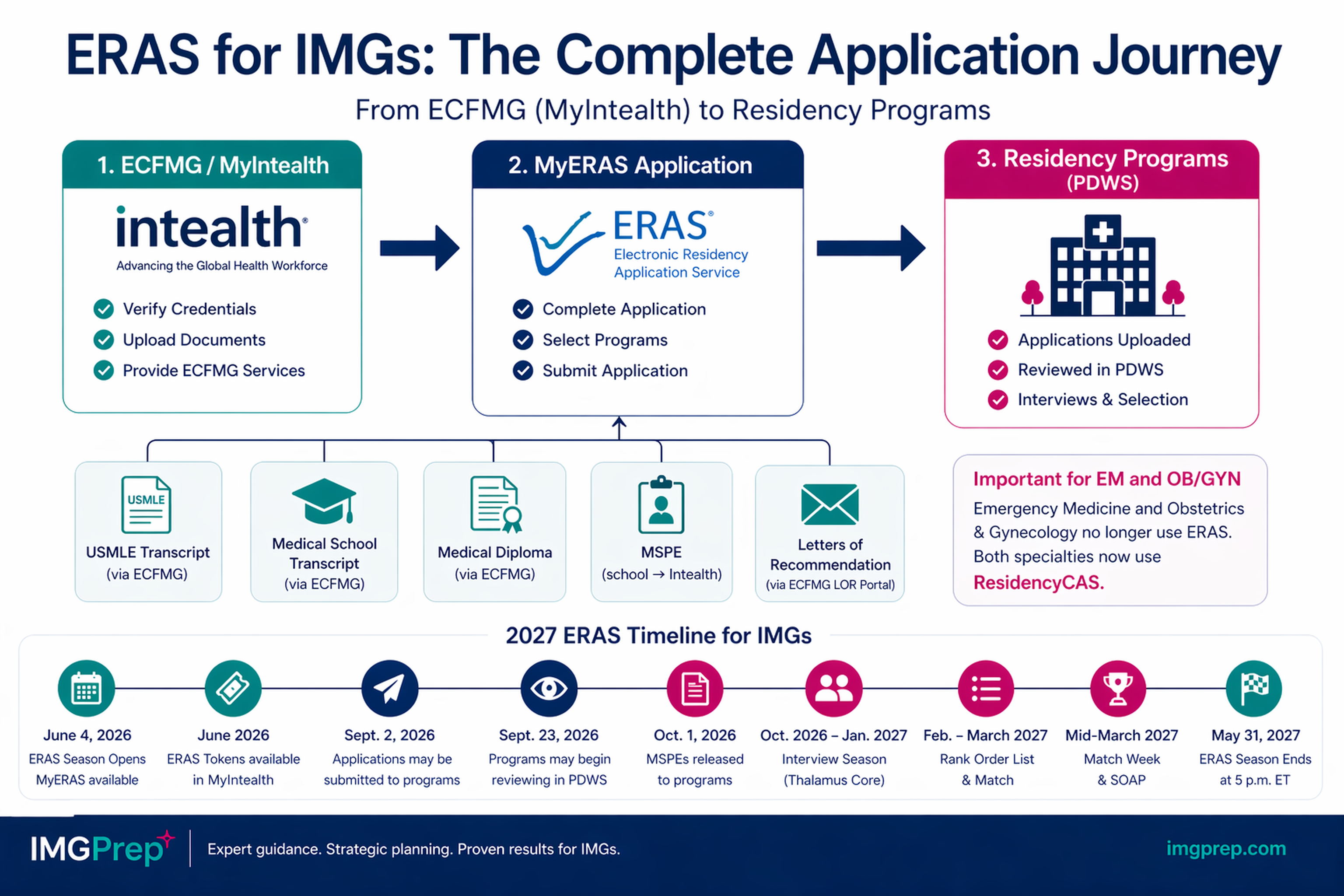
Important for EM and OB/GYN applicants: Emergency Medicine and Obstetrics and Gynecology no longer use ERAS. Both specialties have transitioned to ResidencyCAS. If you are applying to Emergency Medicine, see Why Emergency Medicine Moved from ERAS to ResidencyCAS. All other specialties continue to use the ERAS platform described in this guide.
2027 ERAS Timeline for IMGs: Official AAMC Dates
The 2027 ERAS residency application cycle runs from June 4, 2026, through May 31, 2027. The dates below are published directly by the AAMC and represent the core operational schedule for all residency applicants using ERAS, including IMGs.
| Date | Milestone |
|---|---|
| May 31, 2026 | 2026 ERAS season ends at 5 p.m. ET |
| June 4, 2026 | 2027 ERAS season opens at 9 a.m. ET — MyERAS portal available for application preparation |
| June 2026 | ERAS Tokens become available through MyIntealth for IMG applicants |
| Sept. 2, 2026 | Applicants may begin submitting MyERAS applications to programs at 9 a.m. ET |
| Sept. 15, 2026 (est.) | NRMP Main Residency Match registration opens through R3 system |
| Sept. 23, 2026 | Programs may begin reviewing applications in PDWS at 9 a.m. ET |
| Oct. 1, 2026 | MSPEs released to programs |
| Oct. 2026 – Jan. 2027 | Interview season (virtual and in-person, scheduled through Thalamus Core) |
| Early Feb. 2027 | NRMP Rank Order List entry opens |
| Early March 2027 | NRMP ROL certification deadline |
| Mid-March 2027 | Match Week and SOAP |
| May 31, 2027 | 2027 ERAS season ends at 5 p.m. ET |
Critical gap: The three-week window between September 2 and September 23 exists so ERAS can process and upload submitted applications into the Program Director WorkStation (PDWS). Applications submitted on September 2 are reviewed alongside applications submitted on September 22. For IMGs, this window matters because ECFMG must also verify and upload all supporting documents before programs can complete their review.
The IMG ERAS Process: From MyIntealth to Submission
International medical graduates cannot register directly with AAMC for ERAS. Instead, IMGs access ERAS through ECFMG’s MyIntealth platform, which verifies credentials and serves as the Designated Dean’s Office for all international applicants. The process moves through four sequential steps.
Step 1: MyIntealth Account
Create or log in to your MyIntealth account at intealth.org. This is the unified platform for all ECFMG services, including ERAS support. Identity verification is required.
Step 2: Obtain ERAS Token
Access the ERAS Support Services section within MyIntealth to obtain your residency ERAS Token. Tokens for the 2027 cycle become available in June 2026.
Step 3: Register at MyERAS
Use the token to register at the AAMC’s MyERAS portal. This activates your application and links your ECFMG identity to your residency application file.
Step 4: Build and Submit
Complete your MyERAS application, assign letter writers and documents through ECFMG, select programs, and submit. Programs cannot review until ECFMG uploads your supporting documents.
Documents that IMGs submit through ECFMG rather than directly through MyERAS include the USMLE transcript, medical school transcript, medical diploma, ECFMG Status Report, and letters of recommendation (which writers upload to the ECFMG Letter of Recommendation Portal). The MSPE upload process is also handled through Intealth for IMGs.
For applicants who need a step-by-step walkthrough of ECFMG certification itself—the prerequisite for ERAS eligibility—see ECFMG Certification Step-by-Step Process.
ERAS Application Fees (2027 Cycle)
The AAMC restructured ERAS fees beginning with the 2026 cycle, lowering costs and simplifying the pricing model. For the 2027 cycle, fees continue under this structure. Most applicants save approximately 36 percent compared to pre-2026 seasons.
| Item | Fee | Notes |
|---|---|---|
| Programs 1–30 (per specialty) | $11 each | Fee resets for each additional specialty |
| Programs 31+ (per specialty) | $30 each | Per additional program beyond 30 |
| USMLE Transcript | $80 | Assessed once per season |
| COMLEX-USA Transcript | $80 | Assessed once per season (DOs) |
Fee Example for a Typical IMG Internal Medicine Application
An IMG applying to 50 Internal Medicine programs pays: (30 × $11) + (20 × $30) = $330 + $600 = $930, plus the $80 USMLE transcript fee = $1,010 total through ERAS. This does not include NRMP registration ($85 standard), ECFMG fees for Status Reports, or any document fees charged by ECFMG.
ERAS does not offer refunds for any reason, including applications sent to programs that later become unavailable or programs the applicant withdraws from. For this reason, program selection should be carefully considered before payment. For IMGs developing a targeted program list, see IMGPrep Customized Residency Program Lists.
Components of the ERAS Application for IMGs
The MyERAS application consists of applicant-entered content and supporting documents. For IMGs, the supporting documents flow through ECFMG/Intealth rather than being uploaded directly by the applicant.
MyERAS Application
Personal information, education history, work experiences, Scholarly Work section, volunteer experiences, hobbies, and specialty-specific fields. Completed entirely by the applicant.
Personal Statement
A 750–850 word narrative explaining motivation for the specialty and readiness for residency. See Personal Statement for Residency.
Letters of Recommendation
Up to 4 LORs per program, uploaded by letter writers through the ECFMG LoR Portal. The 2027 cycle expands specialty-specific standardized letter formats for Urology, Dermatology, and Integrated Plastic Surgery.
Emergency Medicine applicants use the Standardized Letter of Evaluation (SLOE), submitted through ResidencyCAS rather than ERAS.
MSPE (Dean’s Letter)
Released October 1. For IMGs, uploaded by the medical school through Intealth. See MSPE Upload Navigation.
USMLE Transcript
Official score report. Requested through ECFMG at a cost of $80, assessed once per ERAS season regardless of programs applied to.
Medical School Transcript & Diploma
Uploaded through ECFMG/Intealth. Must be from the medical school directly or via authorized verification.
ECFMG Status Report
The IMG-specific document confirming ECFMG certification status. Automatically attached and updated by ECFMG throughout the cycle.
Photograph
Professional headshot meeting ERAS specifications. See ERAS Photo Guidelines.
Program Signals
Specialty-specific allotment (typically 3–30) allowing applicants to indicate strong interest to specific programs. Allotments vary by specialty.
Geographic Preferences
Applicants may indicate up to three U.S. geographic regions of preference, with the option to include a brief explanation.
Month-by-Month ERAS Strategy for IMGs
The ERAS application is one of multiple moving pieces that must converge by September 2, 2026. For IMGs, the backward planning from that submission date should begin well before ERAS opens.
Spring 2026 (March–May): Foundation
- Confirm ECFMG certification is complete or in active progress
- Complete remaining USMLE Step exams if outstanding
- Identify and confirm U.S. clinical experience rotations (USCE)
- Begin developing the personal statement and refining the CV
- Establish MyIntealth account and verify identity if not already done
June 2026: ERAS Opens
- Obtain ERAS Token through MyIntealth (available from early June)
- Register at MyERAS and begin building the application
- Assign letter writers and provide them with the ECFMG LoR Portal invitation
- Request USMLE transcript through ECFMG
- Order medical school documents if not already on file
July–August 2026: Document Assembly
- Finalize personal statement and have it reviewed
- Confirm all LORs are uploaded to ECFMG LoR Portal
- Verify MSPE upload is scheduled with medical school
- Finalize program list and assess competitiveness against ECFMG graduation preferences and state licensing requirements
- Plan program signal allocation for your specialty
- Register for NRMP Main Residency Match when registration opens
September 2026: Submit
- Submit MyERAS application on or as close to September 2 as possible
- Verify all documents show “Uploaded” status in ECFMG dashboard
- Confirm programs are receiving your full application on or after September 23
- Begin interview preparation (virtual and in-person protocols, Thalamus Core scheduling)
October 2026 – March 2027: Interview and Match
- MSPEs release to programs October 1
- Monitor email continuously for interview invitations
- Complete interviews October through January
- Build and certify NRMP Rank Order List by the March deadline
- Prepare for SOAP if applicable
Key 2027 ERAS Changes IMGs Should Know
The 2027 ERAS cycle continues the structural evolution that began with the 2025 and 2026 cycles. The most significant changes for applicants are listed below.
Specialty-Specific Standardized Letters
Urology, Dermatology, and Integrated Plastic Surgery now use standardized letter formats developed with specialty organizations to improve consistency and comparability.
EM and OB/GYN on ResidencyCAS
Emergency Medicine (2025) and OB/GYN (2024) have fully transitioned off ERAS. Applicants in these specialties use ResidencyCAS, not MyERAS.
Thalamus Core Scheduling
Thalamus Core is now the unified interview scheduling platform across programs, replacing the patchwork of separate systems programs used previously.
Scholarly Work Section
The traditional Publications section has been replaced by a Scholarly Work section that emphasizes quality, context, and contribution over volume.
Simplified Fee Structure
The $11 (1–30 programs) / $30 (31+) structure introduced in 2026 continues for 2027. Most applicants save roughly 36 percent compared to pre-2026 fees.
Program Signaling Continues
Signaling allotments vary by specialty (generally 3–30). Allocation strategy should reflect genuine interest and realistic competitiveness.
Common ERAS Pitfalls for IMGs
- Delayed ECFMG document upload. Programs cannot review an incomplete application. ECFMG document verification takes time; start early in June so documents are uploaded well before September 2.
- Applying to ERAS for EM or OB/GYN. These specialties are on ResidencyCAS. Applying only through ERAS for Emergency Medicine in 2027 means you have not applied at all.
- Generic personal statements. Programs use the personal statement to evaluate specialty commitment and narrative consistency. Generic statements are filtered quickly.
- Misallocated program signals. Signaling top-tier programs where competitiveness is unrealistic wastes a finite resource. Signals should reflect genuine interest combined with realistic screening alignment.
- Ignoring state licensing constraints. Some states have graduation year thresholds, attempt limits, or USCE requirements that screen out applicants regardless of credentials. Program selection should account for these upstream constraints.
- Certifying the application prematurely. Certification locks the application for the season. Review carefully before certifying; there is no edit path afterward.
- Overapplying without strategy. With the new $30 tier above 30 programs per specialty, submitting to 80 generic programs is expensive and often less effective than submitting to 40 well-matched programs where screening criteria align.
Consult with IMGPrep
The ERAS application for IMGs involves more than document submission. The cycle demands coordination across ECFMG, AAMC, NRMP, letter writers, and the applicant’s medical school, all on a tight timeline with no room for administrative delay.
IMGPrep provides individualized advising for international medical graduates preparing for the 2027 ERAS cycle. Our advisors work with applicants on timeline planning, document preparation, personal statement development, program selection, and application strategy.
Work With IMGPrep on Your 2027 ERAS Application
Get an individualized strategy built around your ECFMG status, USCE, specialty targeting, and the specific requirements of the 2027 cycle.
More on the IMG Residency Application
The ERAS application is one component of the IMG path to residency. The following resources address the other core requirements IMGs must navigate.
ECFMG Certification Step by Step
The full ECFMG certification pathway — the prerequisite for ERAS eligibility.
MSPE Upload in Intealth for IMGs
How the Dean’s Letter reaches programs through the Intealth platform.
Personal Statement for Residency
Structure, strategy, and pitfalls for the ERAS personal statement.
Why EM Moved from ERAS to ResidencyCAS
Platform transition and implications for Emergency Medicine applicants.
The Emergency Medicine SLOE Explained
How SLOEs are generated, interpreted, and weighted in Emergency Medicine residency selection.
SOAP Strategy for Unmatched Applicants
NRMP timeline, eligibility, and IMG-specific SOAP strategy.
ERAS Photo Guidelines
Specifications and best practices for the ERAS applicant photo.
References
- Association of American Medical Colleges. 2027 ERAS Residency Timeline. AAMC Students & Residents.
- Association of American Medical Colleges. 2027 ERAS Residency Timeline for International Medical Graduates (IMG). AAMC Students & Residents.
- Association of American Medical Colleges. Fees for ERAS Residency Applications. AAMC Students & Residents.
- Educational Commission for Foreign Medical Graduates. ERAS Timeline and Fees for IMG Applicants. ECFMG.
- Association of American Medical Colleges. Program Signaling in the 2027 MyERAS Application. AAMC.
- Council of Residency Directors in Emergency Medicine. Emergency Medicine Collaboration with ResidencyCAS. CORD.
- Educational Commission for Foreign Medical Graduates. ECFMG Support for ERAS Applicants. ECFMG.
Contact Us
IMGPrep LLC, 4000 Legato Rd. Suite 1100
Fairfax, VA 22033
Fairfax, VA 22033
Fax: +1 (202) 751-2590