Strategic Guide for Internal Medicine IMGs: Applying Goodness of Fit Theory to Maximize Match Success
March 26, 2026



Understanding the Goodness of Fit Framework
The Goodness of Fit theory suggests that match success depends on alignment between your profile and what programs seek at each selection stage—an approach that defines an effective internal medicine residency IMG strategy. Programs filter candidates through multiple screens—each requiring different strategic positioning. Your goal is to demonstrate fit at every stage: application building, selective screening, holistic review, interview selection, and final ranking.
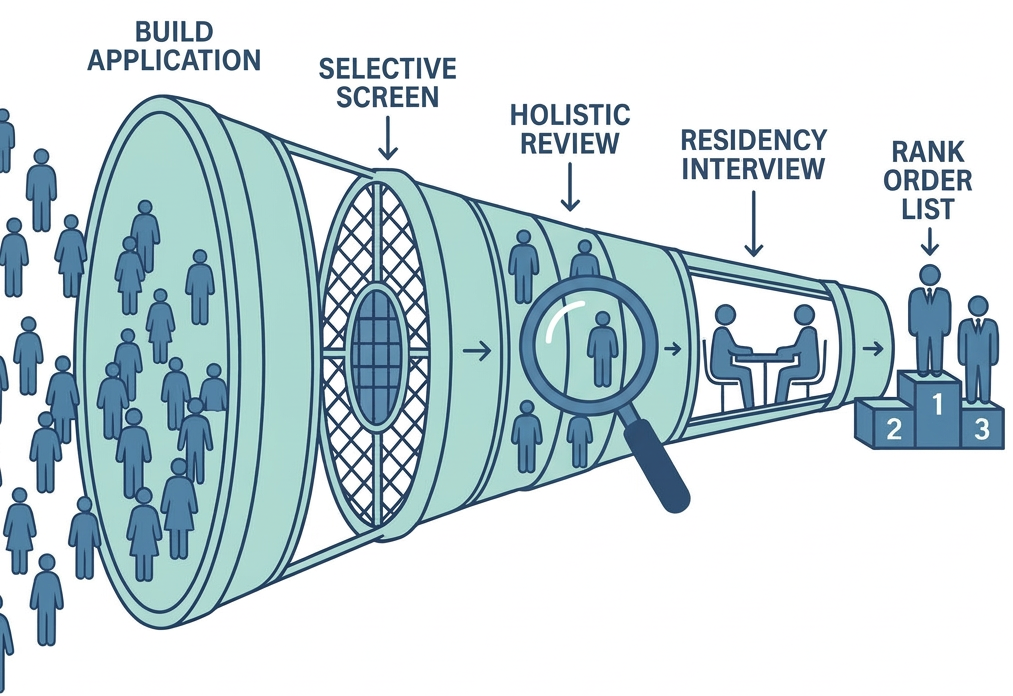
To understand how these stages function in practice, see: Standardized Screening vs Holistic Review in Residency Selection
Stage 1: Building Your Application with Commitment to Internal Medicine
The Challenge
International Medical Graduates face structural disadvantages within the residency selection process. Non-U.S. citizen IMGs match at approximately 56–58%, compared to over 93% for U.S. MD seniors, as reported in the National Resident Matching Program Main Residency Match . Programs receive overwhelming application volumes and rely on sequential filtering mechanisms to manage them.
At this stage, applicants must establish a clear and credible commitment to Internal Medicine. This requires consistent, specialty-specific signals across clinical experience, academic work, and application narrative.
Strategic Actions
Demonstrate Specialty Commitment
Complete hands-on U.S. clinical experiences in Internal Medicine across multiple institutions with direct faculty evaluation. Secure strong, personalized Letters of Recommendation from U.S.-based Internal Medicine physicians. Engage in Internal Medicine–specific research, quality improvement, or case-based work. Participate in professional organizations such as the American College of Physicians and attend academic conferences when feasible.
Optimize Academic Metrics
USMLE performance remains central to screening. With Step 1 pass/fail, Step 2 CK functions as the primary differentiator. Competitive applicants typically score ≥240–245. Take Step 2 CK early and ensure score availability at submission. Address prior failures or gaps directly with evidence of improvement and sustained performance.
Build Meaningful Experiences
Prioritize depth over volume. Longitudinal, high-quality experiences are more effective than superficial activity accumulation. Focus on clinical competence, leadership, service to underserved populations, and functioning within complex care systems. Clearly document outcomes and measurable contributions.
Geographic Strategy
Geographic alignment is developed indirectly through experience. Completing clinical work in target regions can strengthen downstream alignment during application review and interview selection without explicitly influencing application construction.
This stage forms the foundation of an effective internal medicine residency IMG strategy by establishing credible, specialty-specific signals.
Stage 2: Navigating Selective Screening
At this stage, your internal medicine residency IMG strategy must account for how programs apply screening filters.
The Challenge
Programs use initial screening filters to reduce thousands of applications to a manageable subset. IMGs are disproportionately affected at this stage due to visa requirements, variability in training systems, and reliance on objective metrics.
Screening functions as threshold-based filtering, where failure to meet key criteria may prevent further review of the application. Data from the National Resident Matching Program consistently demonstrate that objective metrics, including USMLE performance, play a central role in interview selection.
Strategic Actions
Target Programs Strategically
Apply broadly, typically ranging from 80–150+ programs depending on individual profile strength, visa status, and year of graduation.
Prioritize programs with a demonstrated history of training IMGs. This should be assessed through resident roster review and program composition, rather than assumptions about program type.
Focus on programs where your academic profile, visa status, and clinical experience align with historical match patterns.
Use Program Signaling Wisely
Utilize ERAS signaling to indicate genuine interest in programs where your application demonstrates alignment across multiple dimensions, including clinical experience, geographic ties, or institutional familiarity. The signaling system is administered through the Association of American Medical Colleges ERAS platform.
Program signals reinforce applications that already meet screening criteria. They do not overcome screening filters and should not be used indiscriminately.
Avoid Red Flags
Multiple USMLE attempts, unexplained gaps in training, or inconsistent academic performance significantly reduce the likelihood of passing initial screening, particularly for IMGs.
Address these elements proactively within your application, providing clear evidence of improvement and sustained performance.
The absence of a Medical Student Performance Evaluation (MSPE) represents a structural limitation, as programs rely on it for standardized academic comparison; applications without it are often deprioritized or may not be reviewed during initial screening.
For structured, data-driven program targeting: IMGPrep Customized Residency Program Lists
Most applicants apply broadly without understanding how programs filter IMGs. IMGPrep’s Customized Residency Program Lists identify programs where your application is most likely to pass screening based on visa requirements, academic thresholds, and historical IMG match patterns.
Stage 3: Succeeding in Holistic Review
The Challenge
Holistic review begins once your application is reviewed beyond screening. At this stage, programs interpret your experiences, attributes, and academic metrics collectively.
This process functions as interpretive synthesis, where programs assess whether your application supports a credible assumption of fit within their training environment.
Strategic Actions
Craft a Mission-Aligned Personal Statement
Research the mission, values, and clinical focus of target programs, particularly your top-tier selections.
Align your narrative with program priorities, such as commitment to underserved populations, primary care, academic medicine, or health equity.
Present a structured and coherent explanation of why Internal Medicine, why the U.S. training system, and how your experiences support that trajectory.
At this stage, the personal statement functions as one of the few applicant-controlled signals that shapes how programs interpret your application.
Highlight Your Unique Attributes
Leverage the strengths inherent to the IMG pathway, including multilingual ability, cross-cultural competency, and exposure to diverse healthcare systems.
Frame your trajectory as evidence of adaptability, resilience, and sustained commitment to medical training despite structural barriers.
Structure Your ERAS Application Strategically
Utilize all available experience entries to present a cohesive and aligned application.
Each experience should clearly define your role, demonstrate measurable outcomes, and articulate relevance to Internal Medicine.
Complete the “Most Meaningful Experience” section to provide depth and context beyond descriptive entries. The application is submitted through the Association of American Medical Colleges ERAS system.
Demonstrate Cultural and Systemic Fit
Demonstrate familiarity with the U.S. healthcare system through clinical experiences, research involvement, or volunteer activities.
Highlight your ability to function within team-based care environments, communicate effectively, and adapt to institutional expectations.
For structured application development and narrative positioning: IMGPrep ERAS Application Document Service
Stage 4: Maximizing Interview Selection
The Challenge
A limited proportion of IMG applicants receive interview invitations. Selection reflects a program’s assumption of fit based on the application.
The interview serves as validation of that assumption.
Strategic Actions
Prepare to Defend and Articulate Your Application
You must be able to clearly explain:
What you did
Why you did it
How it supports your commitment to Internal Medicine
Your responses must reinforce the narrative established in your application and demonstrate consistency across all components.
Prepare for Structured Interview Evaluation
Programs assess professionalism, teamwork, communication, and adaptability through structured interviews.
Prepare experience-based responses to: behavioral questions, ethical scenarios, and clinical reasoning discussions.
Applicants who demonstrate clarity, consistency, and self-awareness are more likely to convert interviews into ranked positions.
For structured interview preparation: IMGPrep Residency Interview Preparation
Stage 5: Understanding the Match Algorithm
The Challenge
Although the Match algorithm is applicant-favorable, outcomes depend on rank list construction and interview distribution.
Strategic Actions
Rank to Match
Rank all programs where you would be willing to train.
Order your rank list based on true preference rather than perceived competitiveness, as the algorithm prioritizes applicant choices.
The number of contiguous ranks remains one of the strongest predictors of match success across all applicant groups.
Assess Your Competitiveness Realistically
Applicants with academic or structural challenges, including multiple examination attempts or limited U.S. clinical experience, should construct broader rank lists and include a higher proportion of programs where alignment is strongest.
Stronger applicants may exercise selectivity but should still maintain sufficient rank depth to optimize match probability.
Consider Backup Plans
Prepare for the Supplemental Offer and Acceptance Program (SOAP) by identifying alternative pathways and maintaining application readiness.
Key Principles for IMG Success
Trajectory-Driven Application Development
Once a specialty commitment is established, application development must become intentional and longitudinal. A preparation window of approximately 18–36 months allows for the construction of a coherent professional identity, where clinical experiences, research, professional affiliations, community engagement, and letters of recommendation all align with a defined specialty pathway.
Backward Design from the Five-Year Goal
Applicants are routinely asked to define their five-year trajectory during residency interviews. A credible answer requires backward alignment: each component of the application should demonstrate progression toward that stated goal. The application, therefore, is not a collection of experiences, but a structured progression toward a defined professional endpoint.
Coherence as the Basis of Goodness of Fit
Goodness of fit emerges when the applicant’s stated goals, documented experiences, and interview responses align without contradiction. Programs evaluate whether the trajectory presented is internally consistent and whether the applicant’s development supports the role they are seeking to enter.
Program Selection as a Pathway Decision
The evaluation is bidirectional. Applicants must assess whether a given Internal Medicine program provides an appropriate pathway toward their long-term goals. This includes training structure, patient population, academic exposure, and opportunities for advancement within the chosen field.
Structured Guidance and Longitudinal Planning
The complexity of aligning multi-stage selection criteria with long-term career objectives requires
structured, informed guidance
. Applicants who engage in longitudinal planning are better positioned to construct applications that are not only competitive, but strategically aligned.
Proven Outcomes Across Specialties
IMGPrep has demonstrated consistent match outcomes through long-term trajectory construction across a wide range of specialties, including Internal Medicine, Family Medicine, Pediatrics,
Emergency Medicine
, Neurology, Child Neurology, Psychiatry, Anesthesiology, Physical Medicine and Rehabilitation, Ophthalmology, Dermatology, Neurosurgery, General Surgery, Otolaryngology (ENT), and Orthopedic Surgery. These outcomes reflect a structured, data-driven approach to application development grounded in alignment, timing, and program-specific strategy.
Final Strategy: Aligning Your Application to Match in Internal Medicine
Internal Medicine is not simply accessible—it is selective. Match success depends on aligning your application with how residency programs evaluate candidates across screening, holistic review, and interview selection.
Data from the National Resident Matching Program consistently demonstrate that while Internal Medicine offers the largest number of residency positions, outcomes for international medical graduates vary significantly based on application structure, exam performance, and program targeting.
Most applicants apply broadly without understanding how programs filter, interpret, and rank candidates.
IMGPrep works with international medical graduates to build structured, data-driven residency applications that:
Pass selective screening thresholds
Demonstrate clear and credible fit during holistic review
Convert interviews into ranked positions through strategic preparation
Contact Us
IMGPrep LLC, 4000 Legato Rd. Suite 1100
Fairfax, VA 22033
Fairfax, VA 22033
Fax: +1 (202) 751-2590