
Standardized Screening vs Holistic Review in Residency Selection
March 8, 2026



Introduction
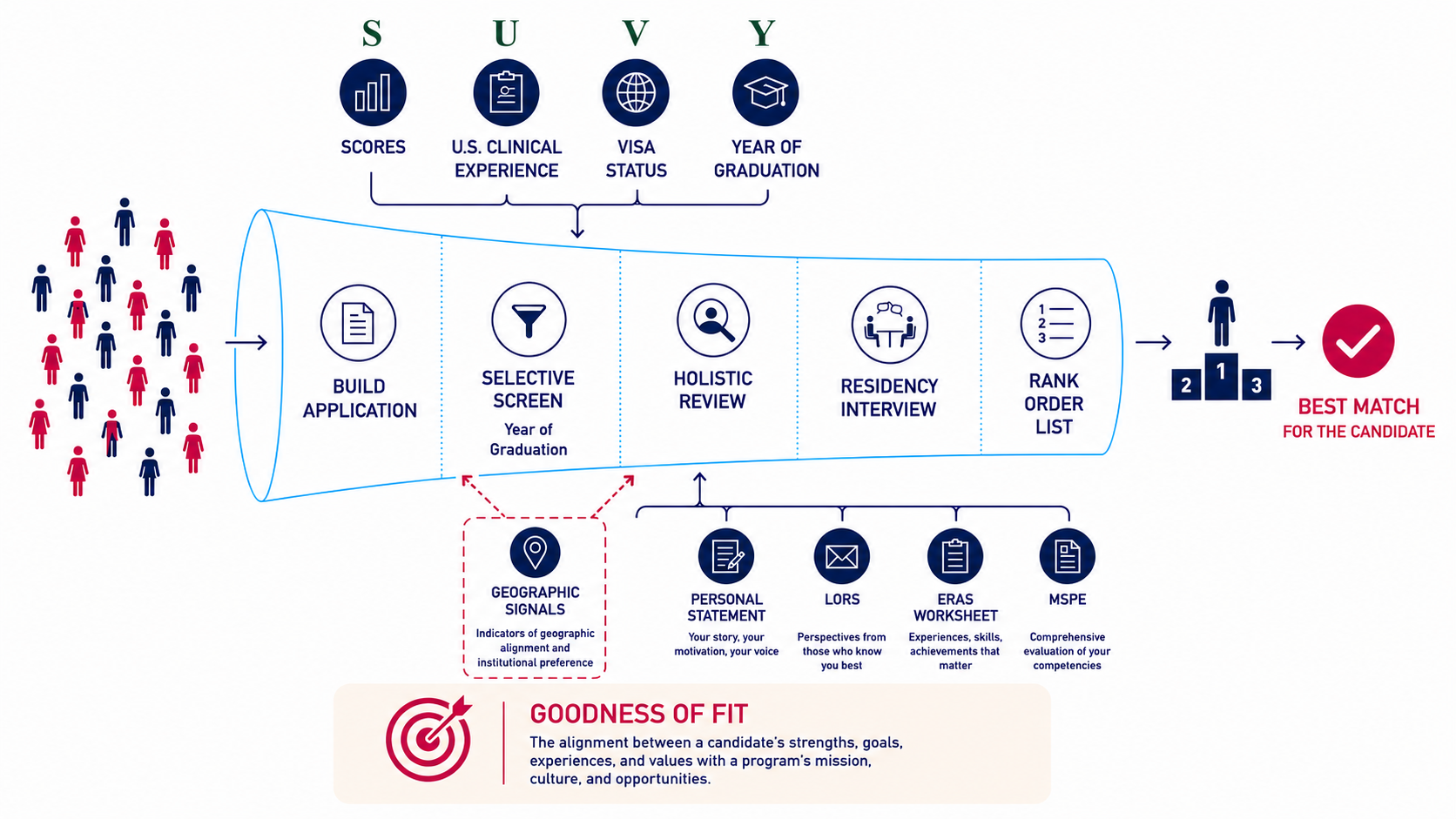
Residency programs typically employ two observable modes of application selection: standardized screening and holistic review. These mechanisms emerge as a practical response to application volume. Programs often receive hundreds or thousands of applications, making immediate holistic evaluation impractical. Screening criteria are therefore used to identify applications eligible for detailed review.
According to the 2024 NRMP Program Director Survey, residency programs receive an average of 924 applications per cycle, with approximately 35.5% rejected through standardized screening before faculty evaluation occurs. Understanding these mechanisms helps clarify why strong applicants sometimes do not receive interviews despite presenting competitive credentials.
The Two Selection Mechanisms in Residency Application Screening
The residency selection process can be conceptualized as a sequential pipeline with distinct evaluation stages:
Application Pool
↓
Standardized Screening
↓
Holistic Review
↓
Interview Selection
↓
Rank List Formation
Applications may exit this pipeline at different stages depending on how they interact with screening parameters and holistic evaluation criteria. Approximately 35.5% of applications are rejected through standardized screening, while 45.5% proceed to holistic review. Of those receiving holistic review, a smaller proportion receive interview invitations.
This pipeline structure explains why residency selection outcomes are influenced not only by applicant qualifications but also by whether an application satisfies the structural screening parameters configured by residency programs. The remainder of this article explains each stage of this selection model.
Standardized Screening
Standardized screening represents a structural triage mechanism that allows residency programs to manage large application volumes before faculty evaluation occurs.
Screening parameters are typically defined by a program leadership group, which may include the program director, associate program director, residency program coordinator, or department leadership involved in recruitment. These individuals determine which eligibility criteria should be applied before applications are reviewed.
The criteria are then configured within the ERAS Program Director Workstation or the program’s application review dashboard. [1-2] These filters can include examination score thresholds, visa sponsorship eligibility, graduation year parameters, required clinical experience, and specialty-specific documentation. Once configured, these parameters function as screening rules applied to the entire application pool.
Research examining internal medicine program directors found that 92% reported an increase in applications, with 64% adjusting recruitment practices in response to application volume. [2] Programs have been described as “excluding qualified applicants through use of numerical screening methods” as a practical response to these volumes. [3]
If an application falls outside a screening parameter, it may be automatically excluded from the review pool, deprioritized in the dashboard, or not opened for faculty evaluation. The critical distinction is that the application is not rejected after holistic review—the application never enters holistic review.
How Residency Application Screening Filters Function in Practice
The following case presentations illustrate how standardized screening parameters affect applications before faculty review occurs.
Case 1: Graduation Year Filter
A physician completed medical school seven years ago. Following graduation, the applicant completed pediatrics residency training and subsequently pursued fellowship training in a pediatric subspecialty. The applicant now seeks to transition into a different specialty and applies to residency programs.
The applicant presents strong credentials: board certification in pediatrics, fellowship training, clinical experience, and strong examination scores. However, many residency programs configure screening parameters that exclude applicants whose medical school graduation occurred more than five years prior to application.
When this application enters the ERAS review system, the graduation year falls outside the program’s configured threshold. The application is automatically filtered before any faculty member reviews the file. The program director never sees the applicant’s clinical experience, fellowship training, or letters of recommendation.
The application is not rejected because of the applicant’s qualifications. The application is excluded because it does not satisfy the program’s structural screening parameters. This represents a fundamental distinction: screening exclusion occurs before evaluation, not after.
For applicants whose graduation occurred several years earlier, maintaining clinical engagement or pursuing additional training may address these structural screening constraints. This issue is explored further in the discussion of strategies for older medical graduates.
Case 2: Visa Sponsorship Filter
An international medical graduate applies to 150 residency programs. The applicant presents competitive credentials: a Step 2 CK score above 240, strong clinical evaluations from U.S. rotations, research publications, and compelling letters of recommendation. However, the applicant requires J-1 visa sponsorship for residency training.
Non-US citizen IMGs must navigate the US visa system, with J-1 and H-1B visas remaining the most common options for residency training. [4] The eligibility criteria, requirements, and processing times can vary significantly for each type of visa, often exceeding the timeline program directors can accommodate to ensure an on-time start. [4]
Among the 150 programs the applicant selected, 45 do not sponsor J-1 visas. These programs have configured a screening parameter within ERAS excluding applicants requiring visa sponsorship.
When the applicant’s 45 applications reach these programs, they are filtered before faculty review. The program directors never evaluate the applicant’s examination scores, clinical performance, or research productivity. The applications are excluded at the screening stage.
The applicant has invested application fees, time preparing materials, and opportunity cost—yet these 45 applications never received faculty consideration. The structural mismatch between applicant eligibility and program parameters resulted in automatic exclusion.
This outcome illustrates why identifying programs aligned with an applicant’s eligibility status is essential when constructing an application list. For resources identifying programs consistent with applicant eligibility factors such as visa policies, see the IMGPrep Residency Program Lists.
Transition to Holistic Review
Applications meeting screening criteria proceed to holistic review, where faculty evaluate the complete application across multiple dimensions. The AAMC has described mission-aligned selection as an approach that considers applicants’ academic metrics, attributes, and experiences to assess job-related competencies and mission-aligned characteristics. [1]
Factors evaluated during holistic review include clinical evaluations, letters of recommendation, academic trajectory, research activity, specialty commitment, and professional attributes. The ERAS application photo is also encountered at this stage as the first visual element of the application file. This stage represents the first point at which faculty judgment meaningfully influences application selection.
Research on residency selection has demonstrated that programs develop scoring rubrics based on experiences, attributes, and metrics domains to facilitate holistic review. [4] These rubrics may include sections on the personal statement, Medical Student Performance Evaluation, curriculum vitae data, academic metrics, and professional indicators.
Holistic Review and Competitive Selection
Passing screening does not guarantee an interview. Applicants who pass screening enter a competitive evaluation stage, where programs compare candidates relative to one another.
Strong applicants may still not receive interviews because of competitive differences in specialty signals or application structure. Even highly qualified applicants may not receive interviews if competing candidates present stronger specialty-specific signals.
This phenomenon—where qualified applicants underperform despite passing screening—is analyzed in greater depth in the discussion of why strong candidates underperform after the filter.
Emergency Medicine as an Illustrative Example
Emergency Medicine provides a useful illustration of how holistic review incorporates specialty-specific evaluation signals. Programs in this specialty place substantial emphasis on the Standardized Letter of Evaluation (SLOE) when assessing applicants.
The SLOE was developed by the Council of Emergency Medicine Residency Directors to provide a fair and accurate assessment of academic and clinical performance, as well as define character attributes pertinent to the practice of emergency medicine. [5] Research has demonstrated that the SLOE is judged by program directors in emergency medicine as the most valuable component of a potential resident’s application. [5]
Survey data from emergency medicine program directors found that composite SLOEs, EM rotation grades, and interview were the most important selection factors. [6] The SLOE allows programs to compare applicants using a consistent format that reflects specialty-specific performance, providing a structured comparative framework during holistic review.
This specialty-specific evaluation mechanism illustrates a broader principle: different specialties assign value to different components of the application during holistic review. For a detailed discussion of specialty-specific evaluation within Emergency Medicine,see the Emergency Medicine IMG Guide.
Emergency Medicine applicants seeking additional context on specialty-specific letters can review the Council of Emergency Medicine Residency Directors SLOE resource.
Attrition in the Residency Selection Pipeline
Residency selection functions as a sequential attrition process. Applications exit the pipeline at different stages depending on how they interact with screening parameters and holistic evaluation criteria.
Across all specialties, approximately 35.5% of applications are rejected through standardized screening, while 45.5% proceed to holistic review. This attrition pattern demonstrates that a substantial proportion of applicants are eliminated before faculty evaluation occurs.
According to the 2024 NRMP Program Director Survey data for Emergency Medicine, programs received an average of 727 applications, with 197 rejected through standardized screening (27.1%) and 525 receiving holistic review (72.2%). Programs sent 220 interview invitations, interviewed 176 applicants, and ranked 158 candidates.
| Emergency Medicine Selection Stage | Average Number | Share of Applications |
|---|---|---|
| Applications Received | 727 | 100% |
| Rejected Through Standardized Screening | 197 | 27.1% |
| Received Holistic Review | 525 | 72.2% |
| Interview Invitations Sent | 220 | 30.3% |
| Applicants Interviewed | 176 | 24.2% |
| Candidates Ranked | 158 | 21.7% |
Conclusion
Residency application screening and selection operates through two distinct mechanisms: standardized screening and holistic review. Understanding the distinction between screening exclusion and holistic evaluation provides a more accurate interpretation of why applicants do or do not receive interview invitations.
Residency application outcomes are influenced not only by applicant qualifications but also by whether an application satisfies the structural screening parameters configured by residency programs. Applications that fall outside screening parameters may never reach faculty review, regardless of the applicant’s underlying qualifications.
For a comprehensive analysis of how these mechanisms function within the broader residency selection pipeline, see the discussion of the NRMP Program Director Survey.
Consult with IMGPrep
Residency selection operates through sequential mechanisms that include standardized screening and holistic review. Understanding how programs configure screening parameters and evaluate applicants during holistic review can significantly influence interview outcomes.
IMGPrep provides structured guidance to help international medical graduates understand residency selection behavior, identify programs aligned with their eligibility profile, and construct applications that remain competitive throughout each stage of the residency selection pipeline.
Consult with IMGPrep to develop a structured residency application strategy based on screening behavior, program compatibility, and competitive positioning.
Search Your Customized Residency Program ListsReferences
- Updates to the AAMC Electronic Residency Application Service Application to Promote Efficient, Effective, and Fair Mission-Aligned Resident Selection. Academic Medicine : Journal of the Association of American Medical Colleges. 2025. Rosman IS, Bolger A, Cunningham TK, et al.
- Internal Medicine Residency Program Directors’ Screening Practices and Perceptions About Recruitment Challenges. Academic Medicine : Journal of the Association of American Medical Colleges. 2020. Angus SV, Williams CM, Stewart EA, et al.
- The Residency Application Process: Pursuing Improved Outcomes Through Better Understanding of the Issues. Academic Medicine : Journal of the Association of American Medical Colleges. 2016. Katsufrakis PJ, Uhler TA, Jones LD.
- International Medical Graduates and the Physician Workforce. The Journal of the American Medical Association. 2024. McElvaney OJ, McMahon GT.
- The Standardized Letter of Evaluation for Postgraduate Training: A Concept Whose Time Has Come? Academic Medicine : Journal of the Association of American Medical Colleges. 2016. Love JN, Ronan-Bentle SE, Lane DR, Hegarty CB.
- Impacts of United States Medical Licensing Examination Step 1 Scoring Change on Emergency Medicine Applicant Screening. The Journal of Emergency Medicine. 2023. Quenzer FC, Coyne CJ, Grey L, et al.
Contact Us
IMGPrep LLC, 4000 Legato Rd. Suite 1100
Fairfax, VA 22033
Fairfax, VA 22033
Fax: +1 (202) 751-2590