
IMG Friendly Programs – Customized Residency Program Lists – What’s Your SUVY?
May 11, 2026



Binary Filters in the Selective Screen: How the SUVY Framework Maps the First Filtering Stage of the Match Funnel
Most applicants think of the residency Match as a competition. The 2026 NRMP data confirms it operates more like a sequence of gates. The first gates are binary — pass or fail, in or out — and they decide a larger share of outcomes than any other stage of the funnel. The SUVY framework maps how these gates operate.
The residency Match is often described in language borrowed from competition: applicants are “strong” or “weak,” programs are “reaches” or “safeties,” and outcomes appear to reward whoever competed hardest. The 2026 NRMP data tells a different story. Selection in the Match operates as a funnel, and the funnel’s first filtering stage is not a competition at all. It is a sequence of binary parameters that an application either satisfies or does not. The SUVY framework — Scores, USCE, Visa, Year of Graduation — is built to map this first stage at the applicant level.
A binary parameter returns one of two values: eligible, or excluded. There is no partial credit. There is no “almost meets the requirement.” When an application reaches a program with a configured binary parameter, the application either proceeds to the next stage of the funnel — where competitive evaluation begins — or is set aside from that program’s review pool.
Understanding which parameters are binary, and where they sit in the funnel, is the foundation of strategic application planning. This is the analytical work that the SUVY framework is built to do.
Consider a concrete case. An applicant graduated from medical school eight years ago. Since graduation, the applicant completed a residency in pediatrics, holds board certification, has authored peer-reviewed publications, and has accumulated strong U.S. clinical evaluations. The application is, by any reasonable measure, accomplished.
The applicant submits to a residency program whose selection criteria specify graduation within the past five years. While the majority of residency programs strive to review applications thoughtfully, high-volume programs — some receiving thousands of applications per cycle — necessarily use selective screening parameters to identify applicants whose profiles align with the program’s training mission and curricular design. The graduation-year parameter is part of that alignment, often reflecting the kind of trainee the program is structured to support.
In this case, the applicant’s graduation year sits outside the program’s parameters. The applicant’s other strengths — board certification, publications, clinical evaluations — are real, but the program’s selection model is calibrated for a different applicant profile. The applicant has not been judged uncompetitive. The applicant has applied where the alignment isn’t present.
This is the operational meaning of a binary parameter inside the selective screen. The applicant in this example does not need a stronger application. The applicant needs a program list composed of programs whose parameters their profile actually fits — programs whose mission and training model align with where they are. Within a single application cycle, the SUVY framework treats this as a structural alignment question, not a credentials question.
The Match Funnel: An Eight-Stage Selection Pipeline
Residency selection is a sequence of distinct operational stages. The IMGPrep Match Funnel maps these stages explicitly so applicants understand which decisions are made when, and by whom.
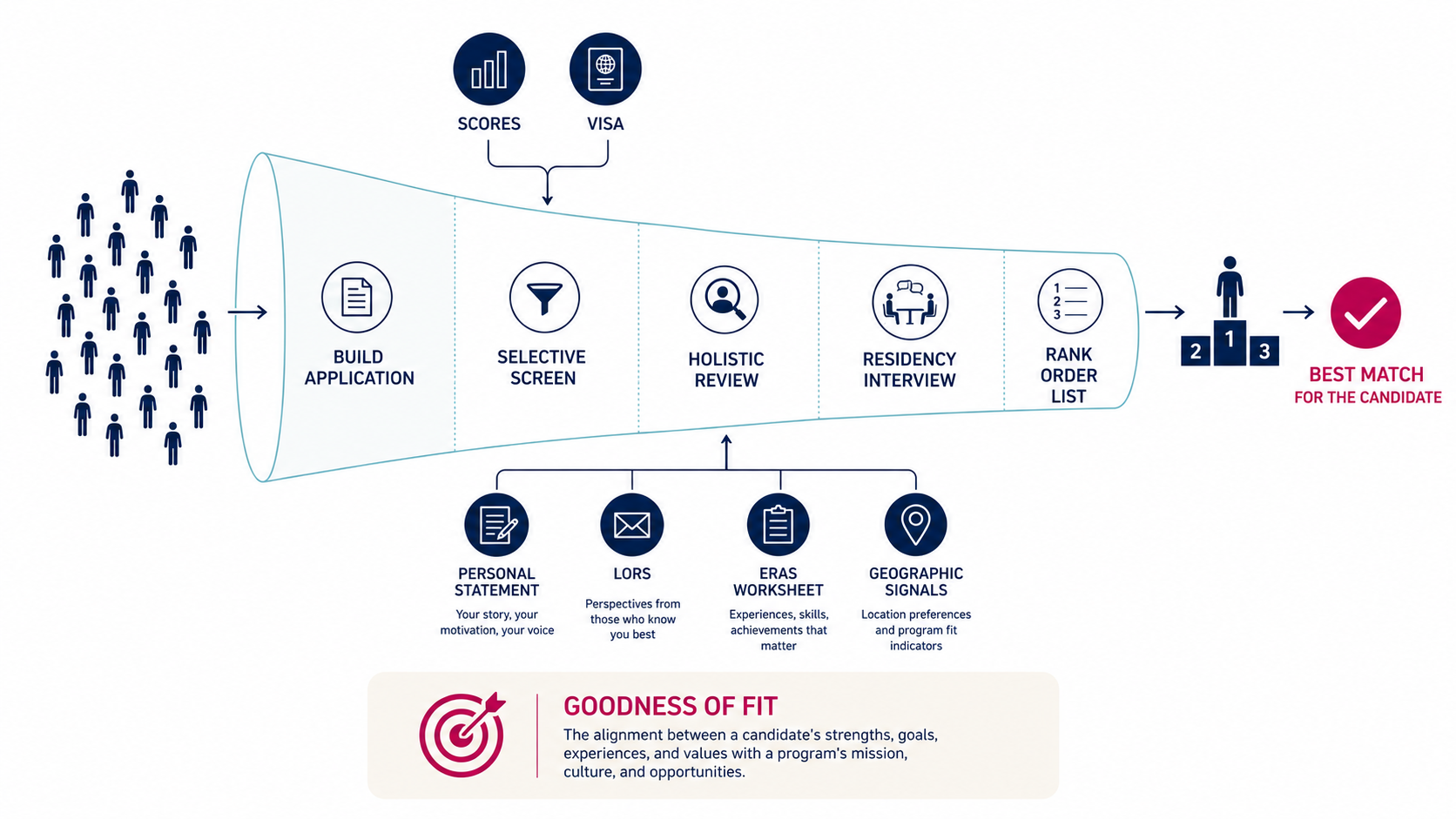
1
Build Application on ERAS
↓
2
Submit Application for Review
↓
3
Selective Screen
↓
4
Holistic Review*
↓
5
Selection for Interview
↓
6
Interview Performance
↓
7
Rank Order List
↓
8
Result — Best Match for the Candidate
* The term formerly known as “Holistic Review” has been renamed by the AAMC to “Mission-Aligned Selection and Retention.” This article uses “Holistic Review” because the term remains in widespread use across residency programs and the IMG community, while noting the formal AAMC terminology update.
This article focuses on Stage 3 — the Selective Screen — where binary and quantitative parameters configured by each program determine which applications proceed to Holistic Review. Goodness of Fit, the framing concept underneath the entire funnel, begins to operate here: the Selective Screen is the program’s first expression of who it is structured to train.
What Makes a Parameter Binary
A binary parameter inside the selective screen has three defining characteristics.
It returns a single bit of information. The applicant either satisfies the criterion or does not. There is no “mostly satisfies” or “satisfies for some purposes.” Visa sponsorship eligibility is binary. Year of graduation relative to a program’s accepted window is binary. ECFMG certification status at the time of program review is binary.
It is configured by the program inside the ERAS Program Director Workstation. Each program decides which parameters reflect its training mission and operational design. There is no universal set imposed from outside; the parameters at any given program are program-decisions.
It is not offset by other elements of the application. A modest score can be offset by strong clinical evaluations during holistic review. A binary parameter, by structure, is not weighted against other dimensions. An application that sits outside a binary parameter is not the application that program’s selection model is calibrated for — regardless of strengths elsewhere in the file.
This is the structural reality the SUVY framework is designed to surface — before an applicant invests application fees, preparation time, and opportunity cost in programs whose parameters do not align with their profile.
Examples of Binary Parameters Programs May Configure
The SUVY framework treats each program’s selective screen parameters as the entry point to alignment analysis. Each residency program configures its own parameters based on its training mission, curricular design, and operational needs. There is no universal list. What follows are examples of binary parameters that appear commonly across programs — but the specific parameters at any given program are program-decisions, and an applicant’s program list should account for the parameters of the specific programs on it.
Example — Visa Sponsorship Status
Does the program sponsor the visa type the applicant requires?
For non-U.S. citizen IMGs, this is the most decisive binary parameter in the 2026 Match. The NRMP disclosed for the first time that non-U.S. IMG match rates split sharply by visa status: 67.9% for permanent residents not requiring sponsorship versus 54.4% for those requiring J-1 or H-1B sponsorship. The 13.5-percentage-point gap is driven by one variable — visa status — with other applicant characteristics held approximately constant. Programs that have not built the institutional infrastructure to sponsor a particular visa category are calibrated for applicants whose profile does not require it.
Example — Year of Graduation
Does the applicant’s medical school graduation fall within the program’s accepted window?
Programs configure graduation-year windows that reflect their curricular design and the kind of trainee the program is structured to support — commonly five years, sometimes three, occasionally seven, and at some programs no fixed window at all. Applicants whose graduation year sits outside the configured window are not aligned with that program’s selection model regardless of credentials accumulated since graduation. Some programs that use longer windows specifically signal openness to older graduates as a deliberate mission feature.
Example — ECFMG Certification Status
Is the applicant ECFMG-certified at the time of program review?
A meaningful share of residency programs require ECFMG certification — confirmed via Intealth — to be in hand at the time of review. Some programs accept pending status; others configure certification as a binary prerequisite tied to onboarding timelines and credentialing requirements for the institution. Where the program treats certification as a prerequisite, pending status is structurally read as not certified.
Example — U.S. Clinical Experience (Yes or No)
Has the applicant completed any U.S. clinical experience?
Some programs configure USCE as a binary parameter for IMG applicants — any U.S. clinical exposure versus none — particularly where the program treats U.S.-system orientation as a structural prerequisite for the kind of trainee the program is built to support. At other programs, USCE is configured as a quantitative parameter (a minimum number of months, weighted by hands-on rotation versus observership). The same dimension can operate as either a binary or quantitative parameter depending on each program’s design.
These are examples, not a fixed canon. Programs configure additional parameters as their mission requires: specialty-specific letter requirements, year-of-graduation paired with continuous clinical engagement, specific scoring patterns on the USMLE, language-of-instruction documentation, and others. The parameters at any given program reflect that program’s training model.
The SUVY Framework: Mapping the Selective Screen
The SUVY framework — Scores, USCE, Visa, Year of Graduation — is the applicant-side mapping IMGPrep developed to operationalize the inputs the Selective Screen evaluates. The framework has a deliberate design feature worth naming explicitly: SUVY captures both binary and quantitative parameters in a single profile, because Selective Screens themselves contain both.
S — Scores. A quantitative parameter. USMLE Step 2 CK and Step 3 scores function as gradient thresholds: most programs configure a minimum, and the higher above the minimum an applicant scores, the broader the eligible program set becomes.
U — U.S. Clinical Experience. Operates as a quantitative parameter at most programs (measured in months, weighted by hands-on rotation versus observership and recency) and as a binary parameter at programs that configure USCE as a yes/no prerequisite. Programs vary in which mode they use; an applicant’s program list must account for both.
V — Visa. A binary parameter. As the 2026 NRMP data demonstrates, visa sponsorship status operates as a structural alignment parameter at the program level. A program either sponsors the visa type the applicant requires or it is calibrated for applicants whose profile does not require sponsorship.
Y — Year of Graduation. A binary parameter relative to each program’s configured window. The applicant is inside the window or outside it; there is no partial credit for being one year past a five-year cutoff.
This is the operational value of the SUVY framework: it tells an applicant which dimensions of their profile are binary (and therefore determine alignment with each program’s Selective Screen) and which are quantitative (and therefore influence competitive position once alignment is established).
Two applicants with identical SUVY profiles may receive different interview outcomes — that is the work of Holistic Review. But two applicants with different SUVY profiles often face different aligned program sets entirely, before Holistic Review enters the picture.
Binary and Quantitative Parameters in the SUVY Framework
The SUVY framework distinguishes between binary and quantitative parameters because the two require different strategy.
Quantitative parameters reward optimization over time. A 220 Step 2 CK score expands the aligned program set; a 240 expands it further; a 260 expands it further still. Time invested in score improvement translates close to linearly into additional aligned programs. The same applies to USCE at programs that configure it quantitatively: additional months of high-quality U.S. clinical experience continue to expand options up to a substantial ceiling.
Binary parameters reward selection, not optimization. An applicant requiring visa sponsorship does not become more aligned with a non-sponsoring program by improving any other element of their application. A graduate seven years past medical school does not become more recent through additional clinical engagement, although structured re-engagement and specific program features can sometimes shift the eligible program set. Within a single application cycle, binary parameters are best treated as fixed inputs that the program list works around — not parameters the application is asked to overcome.
This is why program list construction is decisive for IMG applicants. The list is the lever the applicant controls. The parameters at each program are not.
From Selective Screen to Holistic Review
Applications that the SUVY framework identifies as aligned with a program’s Selective Screen parameters proceed to Stage 4 of the funnel — Holistic Review — where faculty evaluation begins to shape outcomes. Holistic Review is where Goodness of Fit becomes a layered evaluation across the personal statement, letters of recommendation, the ERAS Worksheet, the MSPE, and increasingly, geographic and institutional alignment signals.
The mechanics of Stage 4 — and the broader interaction between standardized screening and holistic faculty evaluation — are addressed in detail in the companion analysis: Standardized Screening vs Holistic Review in Residency Selection. That article examines how programs configure their review processes and how the AAMC’s mission-aligned selection framework shapes faculty evaluation.
Read together, the two articles describe the first half of the Match Funnel: Selective Screen identifies the aligned applicant pool for each program, and Holistic Review evaluates that aligned pool against the program’s training mission.
Strategic Implications for IMG Applicants
Three implications follow directly from applying the SUVY framework to the Selective Screen.
First, alignment precedes competitiveness. An applicant cannot become competitive at a program whose parameters their profile does not match, because the structural fit is not present. Strategic preparation begins with identifying programs whose Selective Screen parameters align with the applicant’s SUVY profile — not with strengthening application elements outside the parameters in question.
Second, application volume does not substitute for alignment. An applicant who submits 200 applications to programs outside their alignment range will not see different outcomes than an applicant who submits 50 to those same programs. Larger application volumes improve outcomes only when each marginal application is targeted at a program whose parameters the applicant’s profile actually fits. Beyond that point, application volume becomes expenditure without yield.
Third, the data infrastructure required to do this work is non-trivial. Selective Screen parameters are not published in a single standardized location. Each program configures its own parameters, and external visibility depends on program website language, prior cycle behavior, residency coordinator communications, and longitudinal tracking of which programs have matched IMGs of which SUVY profiles. This is the underlying purpose of the IMGPrep Customized Residency Program Lists: a curated dataset that maps program-level parameters against an applicant’s SUVY profile.
Conclusion
The Match is not a lottery, and it is not a pure competition. It is a sequential funnel whose third stage — the Selective Screen — is governed by binary and quantitative parameters that determine alignment before competitive evaluation begins. The 2026 NRMP data demonstrates that one of those binary parameters — visa sponsorship status — now drives a 13.5-percentage-point gap in outcomes among otherwise comparable non-U.S. IMG applicants. That gap is the signature of a structural alignment parameter operating at scale across the system.
The SUVY framework exists to operationalize this at the individual applicant level. By mapping a profile against the binary and quantitative parameters configured at each program, the SUVY framework transforms an opaque-looking selection process into structured alignment analysis. The applicant is not asked to outperform the funnel. The applicant is positioned within it — aligned with the programs where Goodness of Fit is genuinely present.
Related Resources
Companion Analysis
Standardized Screening vs Holistic Review
How programs configure ERAS screening parameters and what occurs when an application enters Holistic Review.
Five-Year Analysis
IMG Residency Match Statistics 2022–2026
The full data context behind the 2026 visa-sponsorship finding and the structural stability of the Match.
Program Director Survey
Understanding the NRMP Program Director Survey
A data-driven look at how program directors describe selection behavior across stages.
After the Screen
Why Strong Candidates Underperform After the Filter
What happens to applications aligned with Selective Screen parameters but stalled in competitive evaluation.
Map Your SUVY Profile Against Real Programs
A Residency Match Consultation translates the analysis in this article into a program-level alignment map for your specific SUVY profile — built around the parameters of the programs most aligned with your trajectory.
Schedule a Residency Match Consultation →Contact Us
IMGPrep LLC, 4000 Legato Rd. Suite 1100
Fairfax, VA 22033
Fairfax, VA 22033
Fax: +1 (202) 751-2590