Residency Program Requirements
July 4, 2026



Evidence-Based Analysis · ERAS 2027 / Match 2027 Cycle
Residency Program Requirements: The Structural Filters Every IMG Must Clear Before Holistic Review
Visa policy, year of graduation, USMLE attempts, Step 2 CK floors, ECFMG timing, and U.S. clinical experience: the requirements that decide whether an application is read at all, and how to verify every one of them before you spend a signal or a fee.
Residency selection is not a lottery. It is a sorting mechanism, and the sort begins long before any human being reads a personal statement. Every program publishes, or quietly enforces, a set of residency program requirements: visa sponsorship policy, year of graduation cutoffs, USMLE attempt limits, minimum Step 2 CK expectations, ECFMG certification timing, and U.S. clinical experience thresholds. These operate as structural filters at the top of the selective screening stage of the Match Funnel. An application that fails one of them is removed from consideration algorithmically, regardless of how strong the rest of the file may be.
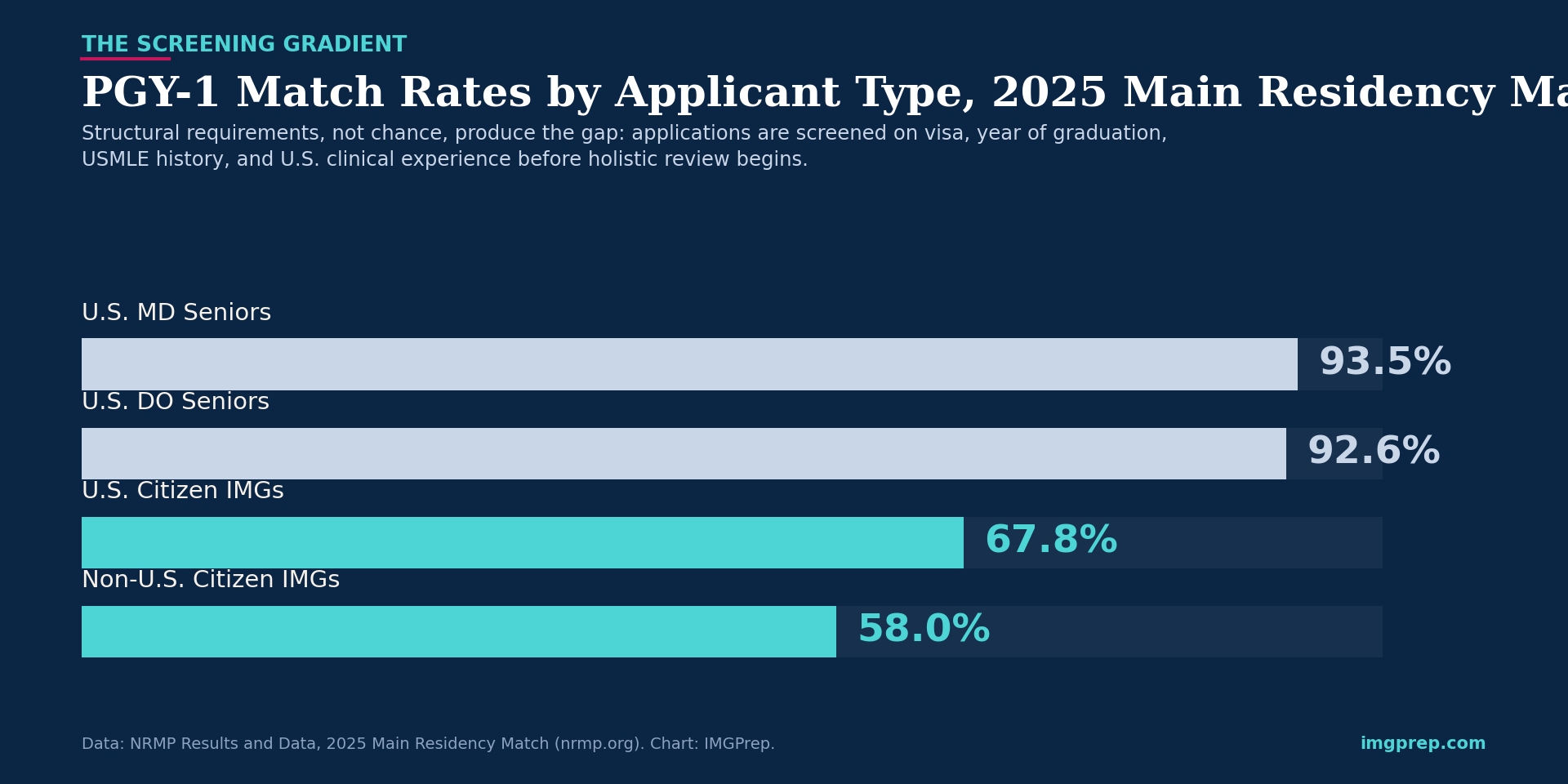
The scale of the pool makes this unavoidable. In the 2025 Main Residency Match, 16,052 active IMG applicants accounted for roughly a third of all active applicants, and the National Resident Matching Program (NRMP) reports PGY-1 match rates of 67.8 percent for U.S. citizen IMGs and 58.0 percent for non-U.S. citizen IMGs, against 93.5 percent for U.S. MD seniors (NRMP, Results and Data: 2025 Main Residency Match). The gap is not a verdict on individual quality. It is largely the arithmetic of structural filters applied to a large applicant pool. The applicants who match are disproportionately those who applied only where they actually qualified, because goodness of fit is decisive.
01Where Program Requirements Sit in the Match Funnel
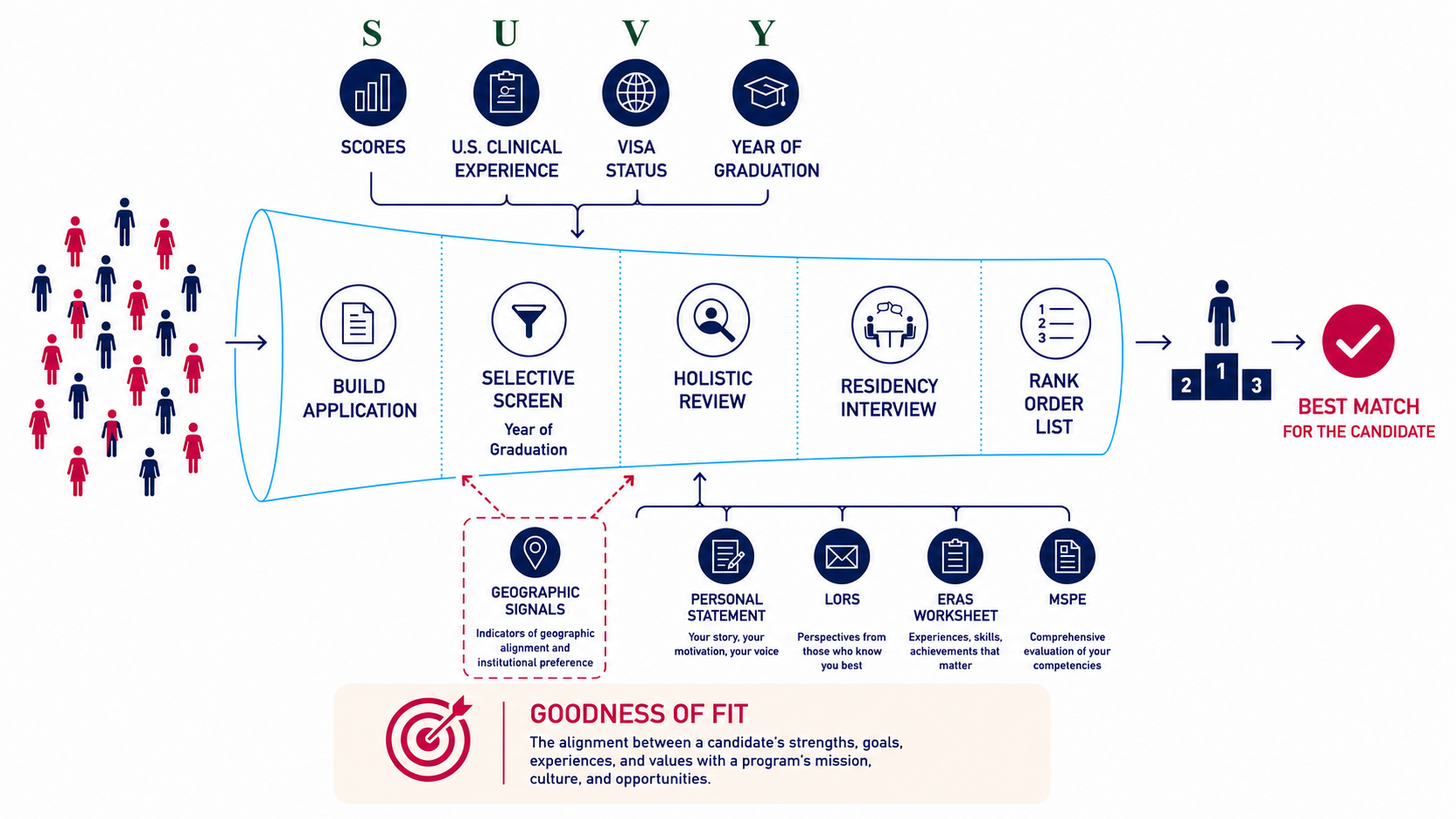
The Match Funnel Model describes six sequential stages: binary filters, quantitative filters, qualitative holistic review, interview selection, interview performance, and ranking. Residency program requirements govern the first two stages, and they are evaluated before any program director reads your narrative.
Stage 1: Binary Filters
Pass or fail conditions. Visa sponsorship offered or not. Year of graduation inside or outside the cutoff. ECFMG certification in hand or pending. USMLE attempts within the program’s limit or beyond it. No score, letter, or interview performance can compensate for failing a binary filter.
Stage 2: Quantitative Filters
Threshold conditions. Step 2 CK score relative to the program’s screening floor, months and type of U.S. clinical experience, research output where the specialty expects it. These filters admit degrees, but only above the floor. Below it, the application is screened out before holistic review begins.
Only applications that clear both stages reach qualitative review, where letters of recommendation, the MSPE, and the personal statement are read. The 2024 NRMP Program Director Survey documents how steep the interview-selection gradient is by applicant type: 91 percent of programs report often interviewing U.S. MD seniors, while 21 percent report often interviewing non-U.S. IMGs (NRMP, 2024 Program Director Survey). The strategic implication is direct: an IMG’s application list must be built from programs whose published and observed requirements the applicant actually satisfies. We analyze the full survey in our NRMP Program Director Survey guide.
02SUVY: The Four Structural Requirements That Screen First
IMGPrep’s SUVY framework organizes the structural requirements that dominate selective screening: Scores, U.S. clinical experience, Visa, and Year of graduation. Every program list should begin with a SUVY audit against each program’s stated requirements.
S · Scores
With Step 1 reported as pass/fail, Step 2 CK is the primary numerical screen. Programs set explicit or informal floors, and many also screen on attempts per Step. Review the current landscape in our USMLE 2026 changes analysis.
U · U.S. Clinical Experience
Programs differ on how much USCE they require, how recent it must be, and whether observerships count or only hands-on rotations. Hands-on U.S. clinical experience with U.S. letters remains the strongest form.
V · Visa
A program that sponsors only J-1 visas is a binary filter for an applicant who requires H-1B, and a program that sponsors neither is closed to any applicant without independent work authorization. Sponsorship policy varies by institution and by state; see our IMG-friendly states analysis.
Y · Year of Graduation
Many programs enforce a year of graduation cutoff, commonly three to five years, sometimes stricter. An application submitted outside the cutoff is screened out algorithmically. Graduates further from medical school should build their lists exclusively from programs whose YOG policies they satisfy.
Not sure how your SUVY profile maps to actual program requirements? Start with the framework, then apply it. What’s Your SUVY? →
03The Evidence: Screening Outcomes by Applicant Type
2025 Match Outcomes Panel
93.5%
of U.S. MD seniors matched to PGY-1 positions in 2025
67.8%
of U.S. citizen IMGs matched to PGY-1 positions in 2025
58.0%
of non-U.S. citizen IMGs matched to PGY-1 positions in 2025
21%
of programs report often interviewing non-U.S. IMGs, vs. 91% for U.S. MD seniors (2024 PD Survey)
Sources: NRMP Results and Data, 2025 Main Residency Match; NRMP 2024 Program Director Survey. Match rates reflect active applicants who certified a rank order list. Applicant behavior differs across groups; see our U.S. IMG vs. non-U.S. IMG analysis and five-year IMG match statistics review.
04The Requirements to Verify for Every Program on Your List
Program requirements are heterogeneous, and the differences are precisely where application strategy is won or lost. Before a program earns a place on your list, and before it earns a signal or an application fee for the ERAS 2027 cycle, verify each of the following against the program’s own stated policy and its observable resident composition.
| Requirement | Filter Type | What to Verify |
|---|---|---|
| Visa sponsorship | Binary | J-1 only, H-1B, both, or none; whether policy differs by department |
| Year of graduation | Binary | Explicit cutoff, and whether recent clinical activity extends it |
| ECFMG certification timing | Binary | Certificate required at application, at interview, or by rank order list deadline |
| USMLE attempts | Binary | Whether any failed attempt disqualifies, or a stated maximum per Step applies |
| Step 2 CK score | Quantitative | Published minimum, plus the observed range among current residents |
| U.S. clinical experience | Quantitative | Months required, recency, and whether observerships satisfy the requirement |
| IMG track record | Fit signal | Current residents’ medical schools and countries; percentage of IMGs in recent cohorts |
Two of these deserve emphasis. First, mission alignment: programs practice mission-aligned selection, and a program whose residents overwhelmingly come from a particular region or school profile is telling you something about its screening behavior that no requirements page states outright. Second, timing: the residency match cycle is unforgiving, and a requirement such as ECFMG certification in hand at application is functionally a calendar requirement. Applicants to the Match 2027 cycle, with Match Day on March 20, 2027, should map their certification and score timelines against each target program’s timing rules months before submission.
Goodness of Fit
An application sent to a program whose structural requirements you do not meet is not an aspirational reach. It is a file that is removed at the selective screening stage, at real cost in fees, signals, and attention. The same application, redirected to a program whose requirements you satisfy and whose mission you match, is algorithmically stable: it survives screening and is judged on its merits. Goodness of fit is decisive.
05Operationalizing Requirements Research: The Customized Program List
Verifying these requirements across hundreds of programs, one website and one FREIDA entry at a time, consumes weeks that most applicants spend during the exact window they should be securing letters and refining documents. This is the problem IMGPrep’s Customized Residency Program Lists exist to solve. Each list is built against your individual SUVY profile and returns only programs whose requirements you satisfy, enriched with the fit signals that published requirements omit: current resident composition and medical schools, IMG percentages, fellowship pathways, attempt policies, ECFMG timing rules, and each program’s stance on U.S. clinical experience.
Applying to programs you qualify for is the single highest-yield decision in the cycle. See only the programs whose requirements you meet. View Program Lists →
The list is the first artifact of a coherent strategy, not the last. Applicants who want the full structural analysis, from SUVY audit through specialty selection and application architecture, work with our advisors through IMG residency match consulting. Those still building the experience side of their profile can pair the list with hands-on U.S. clinical rotations, and applicants targeting programs with a documented IMG history should start with our analysis of IMG-friendly residency programs.
06Related Resources
Build Your List From Requirements You Actually Meet
A SUVY-aligned program list is the difference between applications that are screened out and applications that are read. Start with an evidence-based review of your profile against the ERAS 2027 landscape.
Schedule a Residency Match ConsultationSources: Official NRMP Results and Data, 2025 Main Residency Match, and the NRMP 2024 Program Director Survey Report. Program requirements, visa policies, and screening thresholds change each match cycle. Always verify current requirements on each program’s official website and at nrmp.org before applying.
IMGPrep is not affiliated with the NRMP®, the MATCH®, ECFMG®, Intealth, AAMC®, or ERAS®.
Contact Us
IMGPrep LLC, 4000 Legato Rd. Suite 1100
Fairfax, VA 22033
Fairfax, VA 22033
Fax: +1 (202) 751-2590