


Introduction
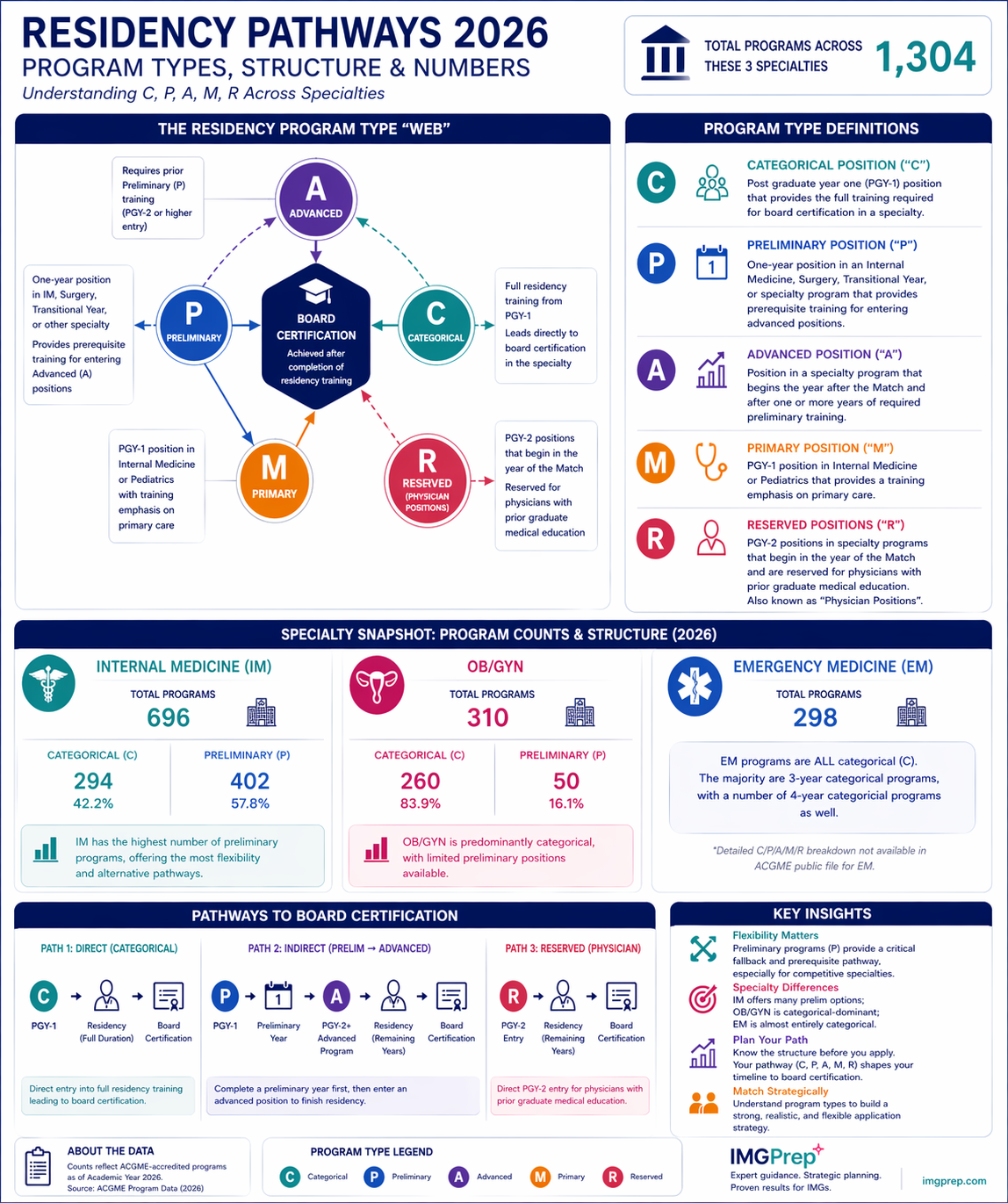
Understanding Preliminary vs Categorical residency positions is the starting point of every residency application decision. As you build your application, you move through multiple stages — gathering letters of recommendation, building your ERAS or ResidencyCAS application, and then submitting through the appropriate platform. When you enter ERAS and start browsing residency programs, you’ll notice that many programs list a single letter next to the specialty name — C or P most commonly, sometimes M, A, or R.
In Internal Medicine and General Surgery especially, you will see the same hospital listed twice: once as “Internal Medicine (C)” and again as “Internal Medicine (P).” These are not duplicates. They are two different positions at the same institution, and the letter determines what you are actually applying to. This article walks through what each letter means, how many programs offer each type, and how the different position types connect to form the full training pathways in each specialty.
C and P: The Two Letters You’ll See Most Often
The most common and well-known Preliminary years you’ll encounter are in Internal Medicine and General Surgery. Those are the two specialties where C and P positions appear side by side most frequently.
C — Categorical
A full-length residency that starts at PGY-1 and continues through to board eligibility. One match covers your full residency training. When you see “Internal Medicine (C),” that program is a complete three-year Internal Medicine residency, and at the end you are eligible to sit for the Internal Medicine boards.
P — Preliminary
A one-year PGY-1 position only. Preliminary programs exist most commonly in Internal Medicine, General Surgery, and as Transitional Year programs. A small number of specialty-specific preliminary programs also exist in Obstetrics and Gynecology and Pediatrics, though these are few. Preliminary positions do not lead to board certification on their own. They exist to provide the foundational clinical year required before an applicant enters an Advanced (A) program for their specialty training starting at PGY-2.
The bottom line: C is complete. P is one year of prerequisite training that has to connect to additional years of training.
Internal Medicine: 696 Programs, 402 Offer Preliminary
According to current ACGME accreditation data for Academic Year 2025–2026, there are 696 Internal Medicine programs in the United States. Of those:
- 402 programs (58%) offer both Categorical (C) and Preliminary (P) positions
- 294 programs (42%) offer only Categorical positions — no Preliminary track
More than half of IM programs in the country operate both tracks at the same institution. When you see an institution listed twice in ERAS — once as “Internal Medicine (C)” and again as “Internal Medicine (P)” — those are two different positions within the same department, at the same hospital, often reviewed by the same program director. What differs is what you commit to if you match.
In the 2026 Main Residency Match, Internal Medicine Categorical offered 11,194 positions and filled 10,657 (a 95.2% fill rate) across 788 program tracks. Medicine-Preliminary (PGY-1 only) offered 1,565 positions and filled 1,430 (a 91.4% fill rate) across 325 program tracks. A C position means three years of Internal Medicine ending in board eligibility. A P position at that same institution means one year of Internal Medicine training, after which you leave to begin an Advanced program elsewhere (or need to apply to the Match again). For a deeper look at how IMGs should approach Internal Medicine, see our Strategic Guide for Internal Medicine IMGs.
General Surgery: Categorical and Preliminary Side by Side
General Surgery is the other specialty where applicants most frequently encounter both C and P positions at the same hospital.
In the 2026 Main Residency Match:
- Surgery (Categorical): 383 programs offered 1,807 positions and filled 1,804 (a 99.8% fill rate)
- Surgery-Preliminary (PGY-1 only): 265 programs offered 1,207 positions and filled 664 (a 55.0% fill rate)
The fill-rate gap tells the story. Categorical General Surgery positions filled almost completely — only 3 positions went unfilled nationwide. By contrast, Surgery-Preliminary filled only 55% of offered positions. Many Prelim Surgery spots serve as a backup pathway for applicants who did not match to Categorical Surgery or to an advanced specialty requiring a preliminary year, which is why fill rates remain relatively low year after year.
Obstetrics and Gynecology: A Smaller Preliminary Track
Although less commonly known, Obstetrics and Gynecology does offer Preliminary positions at a meaningful number of programs. According to ACGME accreditation data for Academic Year 2025–2026, there are 310 OB/GYN programs in the United States. Of those:
- 50 programs (16.1%) offer a Preliminary (P) position in addition to Categorical
- 260 programs (83.9%) offer Categorical positions only
In the 2026 Main Residency Match, OB/GYN Categorical offered 1,638 positions across 310 program tracks and filled 1,636 (a 99.9% fill rate). OB/GYN is predominantly categorical, with a limited Preliminary pathway for applicants using it as a gateway into the specialty or into subsequent training.
Note: Obstetrics and Gynecology transitioned off ERAS and now applies through ResidencyCAS, as does Emergency Medicine.
Specialties That Offer Only C
Not every specialty has a Preliminary track. The following specialties offer only Categorical training — there is no separate Preliminary version, and applicants match once to a complete pathway:
- Family Medicine (83.6% fill rate in the 2026 Match)
- Orthopedic Surgery (100% fill rate in the 2026 Match)
- Otolaryngology (99.8% fill rate in the 2026 Match)
- Neurological Surgery (100% fill rate in the 2026 Match). Neurological Surgery is a seven-year categorical-only program. The PGY-1 year is built into the program itself and includes rotations in neurology, neuro-ICU, and general surgery — so while it functions like a broad first year clinically, it is not a separately matched Preliminary position.
- Pediatrics (94.4% fill rate in the 2026 Match; also offers the Primary Care (M) variant)
- Psychiatry (97.4% fill rate in the 2026 Match)
For these specialties, the primary letter you will see in ERAS is C.
M: The Primary Care Variant in Internal Medicine and Pediatrics
Internal Medicine and Pediatrics also offer a third letter: M.
M — Primary Care
A categorical position in Internal Medicine or Pediatrics with a training emphasis on primary care. M positions are the same length as C positions and lead to the same board certification. The difference is the curriculum — M tracks focus more heavily on outpatient and primary care training, while C tracks provide broader exposure across inpatient and subspecialty rotations.
In the 2026 Match, Medicine-Primary (M) offered 438 positions across 97 program tracks, filling 421 (96.1%). For Internal Medicine, you may see a large academic center list three tracks: Internal Medicine (C), Internal Medicine (M), and Internal Medicine (P). All three are different positions, and applicants can apply to any combination.
What P Connects To: The Advanced (A) Position
The Preliminary year is not a standalone pathway. Instead, it exists to feed into an Advanced (A) program at the PGY-2 level.
A — Advanced
A specialty position that begins at PGY-2, after the applicant has completed a required preliminary year. When an applicant matches to an Advanced program, they must separately match to a Preliminary program for their PGY-1 year. Without a P match, an A match cannot be completed.
The practical flow looks like this:
- Year 1 (PGY-1): Preliminary position — typically Prelim Internal Medicine, Prelim Surgery, or a Transitional Year
- Years 2+ (PGY-2 onward): Advanced program in the target specialty
Specialties that commonly offer A positions include Diagnostic Radiology, Dermatology, Neurology, Anesthesiology, Physical Medicine and Rehabilitation, and Radiation Oncology. Because applicants must match twice in the same cycle, ranking strategy matters — see our Supplemental Rank Order List Guide for how to structure this properly.
Example: Diagnostic Radiology
Diagnostic Radiology is the classic specialty that follows a Preliminary year. In the 2026 Match, Diagnostic Radiology offered 1,083 Advanced (PGY-2) positions across 173 program tracks, and 156 Categorical (PGY-1) positions across just 34 program tracks — meaning roughly 87% of Diagnostic Radiology positions are Advanced. An IMG applying to Diagnostic Radiology will typically apply to:
- Preliminary Internal Medicine or Transitional Year programs (for the PGY-1 year)
- Advanced Diagnostic Radiology programs (for PGY-2 through PGY-5)
The applicant must match to both. Match only the A and you have no PGY-1 year. Match only the P and you have a one-year job with no specialty training to follow.
Transitional Year (TY): Another Path Into Advanced Programs
There is one more PGY-1 pathway that feeds into Advanced positions: the Transitional Year (TY).
A Transitional Year is a one-year ACGME-accredited program that rotates residents through multiple disciplines — typically Internal Medicine, Surgery, Pediatrics, Emergency Medicine, and elective blocks. TY programs offer broader clinical exposure than Preliminary Medicine or Preliminary Surgery, and they are often favored by applicants heading into lifestyle-oriented specialties.
In the 2026 Match, there were 1,937 Transitional Year positions offered across 239 program tracks, with 1,746 filled (a 90.1% fill rate).
Like Preliminary Medicine, Transitional Year programs serve as the PGY-1 that feeds an Advanced program in specialties such as Diagnostic Radiology, Dermatology, Radiation Oncology, Ophthalmology, PM&R, and Anesthesiology. For example, an applicant applying to Advanced Dermatology may rank a combination of Preliminary Medicine programs and Transitional Year programs on their supplemental rank order list as acceptable PGY-1 options.
Anesthesiology and Neurology: Categorical Is Now the Dominant Track
Historically, Anesthesiology and Neurology were structured primarily as Advanced programs requiring a separate Preliminary year. That has changed substantially, and the 2026 Match data makes the shift clear.
Anesthesiology (2026 Match)
- Categorical (PGY-1): 200 programs, 1,865 positions — 100% filled
- Advanced (PGY-2): 50 programs, 306 positions — 100% filled
- Categorical share: approximately 86% of all Anesthesiology positions
Neurology (2026 Match)
- Categorical (PGY-1): 171 programs, 1,003 positions — 99.6% filled
- Advanced (PGY-2): 37 programs, 233 positions — 100% filled
- Categorical share: approximately 81% of all Neurology positions
For both specialties, an applicant will still see C and A positions in ERAS, but the balance has shifted decisively toward C. An IMG applying to Anesthesiology or Neurology today is more likely to end up in a C program than in a P + A combination, though a meaningful Advanced track still exists in both specialties.
Emergency Medicine: Two Different Categorical Lengths
Emergency Medicine is unique. It is a Categorical-only specialty — there are no Advanced Emergency Medicine positions, and no preliminary year is required. However, unlike other categorical specialties, Emergency Medicine offers Categorical training in two different lengths:
- PGY 1–3 (three-year Emergency Medicine residency) — the more common format, used by approximately 75 percent of programs
- PGY 1–4 (four-year Emergency Medicine residency) — used by the remaining 25 percent
Both formats lead to the same board certification. The American College of Emergency Physicians supports both lengths, and there is no evidence that one format produces better outcomes than the other. Four-year programs typically include additional training in research, ultrasound, administration, or a subspecialty area. Three-year programs move residents into practice one year earlier.
In the 2026 Match, Emergency Medicine offered 3,198 positions across 303 program tracks, filling 3,058 (a 95.6% fill rate). For IMG applicants, the choice between three-year and four-year Emergency Medicine programs is a personal and professional one — there is no structural disadvantage to either format.
Example of an IMG-Friendly 3-Year EM Program
Rutgers Health / Newark Beth Israel Medical Center Program (ID 1103321158) is a three-year Categorical Emergency Medicine residency located in Newark, NJ. It is an IMG-friendly program and a strong example of the PGY 1–3 EM format. You can view the full program details — including application requirements, deadlines, and program leadership — on the IMGPrep program directory page linked above.
To learn how IMGs can identify and target IMG-friendly EM programs more broadly, see our IMG Friendly Emergency Medicine guide. For applicants who need to understand the platform shift from ERAS to ResidencyCAS, see Why Emergency Medicine Moved from ERAS to ResidencyCAS.
R: The Re-Entry Pathway (Not for Senior Medical Students)
The fifth letter you may see is R.
R — Physician Reserved
A PGY-2 position reserved for physicians who have already completed prior graduate medical education. R positions are not available to senior medical students or first-time Match applicants. They are intended for physicians who completed one or more years of U.S. residency training and are now entering a different or advanced specialty at the PGY-2 level.
In the 2026 Match, 354 Physician (R) positions were offered across 196 programs, with the largest concentrations in Anesthesiology (119 positions, 96.6% filled), Diagnostic Radiology (29), Dermatology (25), Neurology (24), and PM&R (14).
For IMGs, R positions become strategically relevant in a specific scenario: an IMG who matches to a Preliminary year (PGY-1), completes it successfully, and then reapplies to the Match in the following cycle can target R positions in the specialty they actually want. This is a legitimate — though planned — pathway into competitive specialties for IMGs who did not match to their target specialty in their first cycle. If you find yourself unmatched, our SOAP 2026 Guide walks through your Match Week options.
Consult with IMGPrep
Deciding which position types to apply to, how to balance categorical and preliminary options, and how to structure your rank order list are among the most consequential choices in the residency application process. The selection should initially address the binary screening filters, but more importantly it should reflect who you are and what you specifically are looking for in a program. For IMGs, these decisions also intersect with visa timelines, state licensing constraints, and funding rules that affect training continuity.
IMGPrep’s Customized Residency Program Lists go beyond the SUVY algorithm’s competitiveness targeting — they also include sub-filters for specialties like Internal Medicine and General Surgery that delineate Preliminary (P) from Categorical (C) positions at each program, along with a condensed mission statement summarizing each program and available fellowships. You see exactly which track is available where, what the program stands for, and what training continues beyond residency — program by program. No other service provides this level of detail.
Build Your Residency Strategy With IMGPrep
Get a program list built on the SUVY algorithm with specialty sub-filters that separate Categorical from Preliminary tracks, summarize each program’s mission, and identify available fellowships.
More on the IMG Residency Application
References
- National Resident Matching Program. Advance Data Tables: 2026 Main Residency Match. NRMP; March 20, 2026.
- National Resident Matching Program. NRMP Releases Results of the 2026 Main Residency Match. Press release; March 20, 2026.
- Accreditation Council for Graduate Medical Education. List of Accredited Internal Medicine Programs, Academic Year 2025–2026. ACGME Public Program List.
- Accreditation Council for Graduate Medical Education. List of Accredited Obstetrics & Gynecology Programs, Academic Year 2025–2026. ACGME Public Program List.
- Accreditation Council for Graduate Medical Education. List of Accredited Emergency Medicine Programs, Academic Year 2025–2026. ACGME Public Program List.
- National Resident Matching Program. 2026 Match Results by State, Specialty, and Applicant Type. NRMP; March 2026.
- National Resident Matching Program. The Match Terms and Topics. NRMP; 2026.
- American College of Emergency Physicians. Length of Emergency Medicine Residency Training. ACEP.
- Accreditation Council for Graduate Medical Education. Program Accreditation Standards. ACGME; 2026.