Residency Interview Questions: How to Answer Them Strategically
May 4, 2026



IMGPrep Strategic Analysis · Application Strategy · 2026
Residency Interview Questions for IMGs
By the IMGPrep Editorial Team · 20+ Years Advising IMGs · Updated 2026 · Verified against NRMP & ACGME
Residency interview questions are most often searched as a list of common prompts and sample answers. That framing captures only the surface. Residency interviews are part of a structured evaluative sequence in which the program tests whether the person encountered in the interview substantiates the promise suggested by the written application.
99.5%
Of programs cite the interview as the most important factor in ranking decisions (2024 NRMP)
85%
Of programs cite the MSPE when deciding whom to interview
1/3
Of applicants are ranked more favorably after the interview — another third less favorably
Before an interview is offered, the application has already moved through stages of review. Standardized screening identifies whether the application meets threshold criteria; subsequent holistic review allows the program to develop a more integrated impression of the candidate.[1][2] At that stage, the program does not arrive at certainty. It forms a working assumption: that this applicant may represent a plausible and potentially valuable fit for the specialty, the training environment, and the institutional culture of that particular residency program.
That distinction matters. The residency interview is not a blank slate, nor is it simply an opportunity to repeat what is already on the application. Its function is more precise. The interview tests whether the candidate’s manner of thought, communication, self-awareness, and professional judgment support the working assumption already generated during review.[3] Residency interview questions, then, should not be approached as generic prompts requiring generic responses. They should be approached as opportunities to confirm, refine, and deepen the program’s preliminary impression.
The IMGPrep Diagnostic Reasoning Model
The residency selection process closely resembles the diagnostic reasoning used in clinical medicine. Physicians rarely arrive at a diagnosis from a single piece of information. They gather data from multiple sources—history, examination, laboratory findings—and gradually develop a working diagnosis that is refined as additional evidence emerges.
Residency selection follows a similar logic. Programs begin with a large pool of applications and gradually gather evidence at successive stages of review. Each stage refines the program’s interpretation of the candidate. The interview is the final stage at which programs gather direct, in-person evidence before committing to a rank order list.
Conceptual Framework
IMGPrep Diagnostic Reasoning Model
Residency Selection as Sequential Evidence Gathering
ERAS Application
MSPE · Letters of Recommendation · Personal Statement
↓
Standardized Screening
Visa Status · Step 2 CK · Graduation Year
Pass threshold-based screening ✓
Fail threshold screening ✗
↓
Holistic Review
MSPE · Letters · Scholarly Activity · Clinical Trajectory
Coherent narrative aligns with program ✓
Narrative does not support program fit ✗
↓
Working Assumption of Fit
Program forms a preliminary hypothesis about the candidate
Strong working assumption ✓
Weak working assumption ✗
↓
Interview
Testing the Working Assumption of Fit
Interview reinforces alignment ✓
Interview contradicts assumption ✗
↓
Goodness of Fit
Application evidence + Interview performance
↓
Rank Order List
Stronger Goodness of Fit → Higher Placement
↓
MATCH
Higher rank placement → Greater probability of match
Stage 1: Standardized Screening
Residency programs receive hundreds, and sometimes thousands, of applications. Many programs begin with standardized screening criteria to manage volume and identify candidates who meet baseline eligibility thresholds. Common screening variables include USMLE performance, graduation year, visa requirements, number of examination attempts, and presence of U.S. clinical experience.[4]
In Internal Medicine, USMLE Step 2 Clinical Knowledge scores are the criteria most frequently reported as “very important” by program directors (57%), though when asked to identify a single most important criterion, non-USMLE criteria were collectively more frequently cited (68%).[4] Screening criteria alone do not determine interview invitations — but they determine which applications are read at all. Applicants should ensure they maximize the reach of their application by applying to programs whose filters they actually meet.
Stage 2: Holistic Review and the Formation of a Working Assumption
Applications that pass Standardized Screening undergo Holistic Review, during which program directors evaluate the broader context of the application. According to the NRMP Program Director Survey, the principal factors considered when deciding whom to interview include the Medical Student Performance Evaluation (MSPE), letters of recommendation in the specialty, grades in required clerkships, and class performance, followed by elements such as the personal statement and evidence of scholarly or clinical engagement.[1]
Together, these materials allow programs to interpret the applicant’s professional identity beyond numerical metrics. Consistent with mission-aligned selection, reviewers may also consider leadership, service, community engagement, and alignment with the populations served by the program.[5] Structured rubrics based on program mission and values guide this review, with some programs reporting that holistic review requires approximately 15–20 minutes per application.[1]
From this synthesis of evidence, programs develop a Working Assumption of Fit — a preliminary interpretation that the applicant’s experiences, motivations, and professional trajectory align with the training environment. Although emphasis varies across specialties — for example, Emergency Medicine places particular weight on the Standardized Letter of Evaluation (SLOE) — programs ultimately use these materials to determine which applicants warrant further evaluation through the residency interview process.
Stage 3: The Residency Interview as Additional Evidence Gathering
Once an applicant is invited to interview, the program has already formed a preliminary hypothesis about the candidate. The residency interview becomes an opportunity to gather additional evidence that refines, tests, and potentially confirms or revises that working assumption.
National data confirm the importance of this stage. Across all specialties surveyed, the interview was considered the most important factor (99.5%) in ranking decisions.[6] In one general surgery program, only USMLE Step 2 scores and interview performance remained significant predictors of rank list position on multivariate analysis — with interview performance the strongest predictor of all.[7]
Categories of Residency Interview Questions
Residency interview questions are not random. Programs use different question types to gather evidence about distinct dimensions of an applicant’s professional identity, judgment, and interpersonal skills. The four categories below cover the most frequently asked questions across U.S. residency programs, organized by the type of evidence each question is designed to surface.
Click each category to expand the full list of questions.
Core Questions Establishing professional identity, specialty commitment, and program fit. 15 questions
- Tell me about yourself
- What made you want to become a doctor
- Why did you choose this specialty
- Why did you choose to apply to our program
- What makes this program special to you
- What do you feel you could add to our program
- Why should we choose you over another applicant
- What is one of your strengths
- What is one of your weaknesses
- Where do you see yourself in five to ten years
- What are your long-term goals
- How would your friends describe you
- What factors would lead you to rank a program high
- What do you think we are looking for in a resident
- Are you planning a subspecialty? In what field
These questions evaluate whether the applicant’s motivations and trajectory align with the narrative already presented in the written application.
Peripheral Questions May appear informal but reveal personality and emotional intelligence. 9 questions
- How do you handle stress
- What do you do to cope with stress
- Tell me about a book you have read recently that is not related to medicine
- What do you enjoy doing outside of medicine
- What are your interests outside of medicine
- Tell me about your hobbies
- What do you do in your free time
- What are you most proud of
- What kind of superhero would you be and why
These questions help programs assess curiosity, composure, and reflective capacity beyond the application.
Behavioral Questions Evaluate how applicants have responded to real experiences. 14 questions
- Tell me about a time you faced conflict with a colleague and how you handled it
- Describe a difficult clinical situation
- Tell me about a mistake you made and what you learned
- Tell me about a time you were disappointed in your performance
- Tell me about a difficult decision you have made
- Tell me about a patient you had trouble dealing with
- Tell me about your biggest success
- Describe a difficult time in your life
- Have you held any leadership roles
- How do I know you can show initiative and are willing to work
- Tell me about your clinical experience
- Tell me about your U.S. clinical experience
- Do you have publications? Are you interested in research
- Tell me about your volunteer work
Programs evaluate transparency, reflection, and the ability to learn from experience rather than the event itself.
Ethical Questions Assess reasoning through complex clinical and professional dilemmas. 9 questions
- How would you handle a colleague who made a medical error
- What would you do if a patient refused life-saving treatment
- How should physicians respond to ethical conflicts in care
- What would you do if you saw a colleague act unethically
- What are the critical aspects of communication with patients
- What is a current issue the healthcare system is facing
- What challenges do you think this specialty may face in the future
- What can you say about negative aspects of this specialty
- What will you do if you do not match
These questions evaluate judgment, professionalism, and ethical reasoning under uncertainty.
Logistics and Closing Questions
Most residency interviews include a small set of administrative or closing questions. They are not opportunities to differentiate the applicant in the same way the four categories above are, but they should be answered with the same precision and preparation.
- What is your USMLE score? How many attempts
- What is your visa status
- To what other programs have you applied
- Tell me about your medical education
- Do you have any questions for me
The final question — “Do you have any questions for me?” — is universal. Treating it as a throwaway closing is one of the most common interview mistakes. The questions an applicant asks are themselves evaluated as evidence of preparation, curiosity, and program-specific interest.
Emerging Interview Formats: The Multiple Mini Interview
Some residency programs have adopted structured formats such as the Multiple Mini Interview (MMI). Applicants rotate through short stations designed to assess competencies including communication skills, ethical reasoning, and professionalism. Although the format differs from traditional interviews, the objective remains the same: gathering evidence about whether the applicant demonstrates qualities consistent with success in residency training.
Critical Evidence: How the Residency Interview Works on the Initial Assumption
Research demonstrates that interviewers heavily emphasize candidates’ application files when evaluating interviews. In a mixed-methods study of anesthesiology residency selection, qualitative analysis revealed that interviewers focused on candidates’ academic records and favored candidates whose interview behaviors were consistent with their applications.[3] The study concluded that “residency candidates’ application files predisposed interviewers’ experience and evaluation of interviews.”[3]
This finding provides direct empirical support for the framework presented in this article: the residency interview serves as additional evidence gathering that allows programs to test the Working Assumption of Fit established during application review. The application creates the initial hypothesis; the interview provides the data to refine that hypothesis into a final ranking decision.
An earlier study demonstrated that interviews can substantially influence ranking: approximately one-third of applicants were ranked more favorably after interviews, one-third less favorably, and one-third remained unchanged.[8] The application establishes the initial assumption; the interview provides critical additional evidence that can either strengthen or weaken that assumption.
In other words, once the application has established a plausible case for the candidate, the residency interview becomes the stage where programs gather additional evidence to determine whether the individual encountered in conversation supports, refines, or challenges that initial interpretation.
What Programs Are Evaluating in Residency Interviews
During the earliest stage of application processing, residency programs apply Standardized Screening to manage the large volume of applications they receive. This stage corresponds to what the NRMP Program Director Survey describes as the factors used to select applicants to interview — the determinants of which applications advance to deeper review.
Some of these factors function primarily as administrative eligibility markers, such as visa status, which may determine whether a program can consider the application at all. Others operate as quantitative academic indicators — most notably licensing examination scores, which allow programs to compare applicants using standardized metrics and often function through threshold-based filtering. A third category includes variables such as graduation year. Although graduation year is itself a quantitative measure, it is frequently interpreted through qualitative assumptions about clinical recency, familiarity with current medical practice, and readiness to re-enter structured training environments.
Once an application advances beyond Standardized Screening, faculty begin the more interpretive process of Holistic Review. At this stage, reviewers examine the materials that collectively represent the applicant’s professional identity — MSPE, letters of recommendation, personal statement, scholarly activity, and clinical trajectory.
Taken together, these materials allow programs to develop a Working Assumption of Fit. The residency interview then becomes the stage in which this Working Assumption of Fit is tested. Through conversation and structured questioning, programs gather additional evidence that either reinforces or challenges this interpretation. The ultimate objective of this process is the evaluation of Goodness of Fit, which informs placement on the program’s Rank Order List.
IMGPrep Interview Preparation
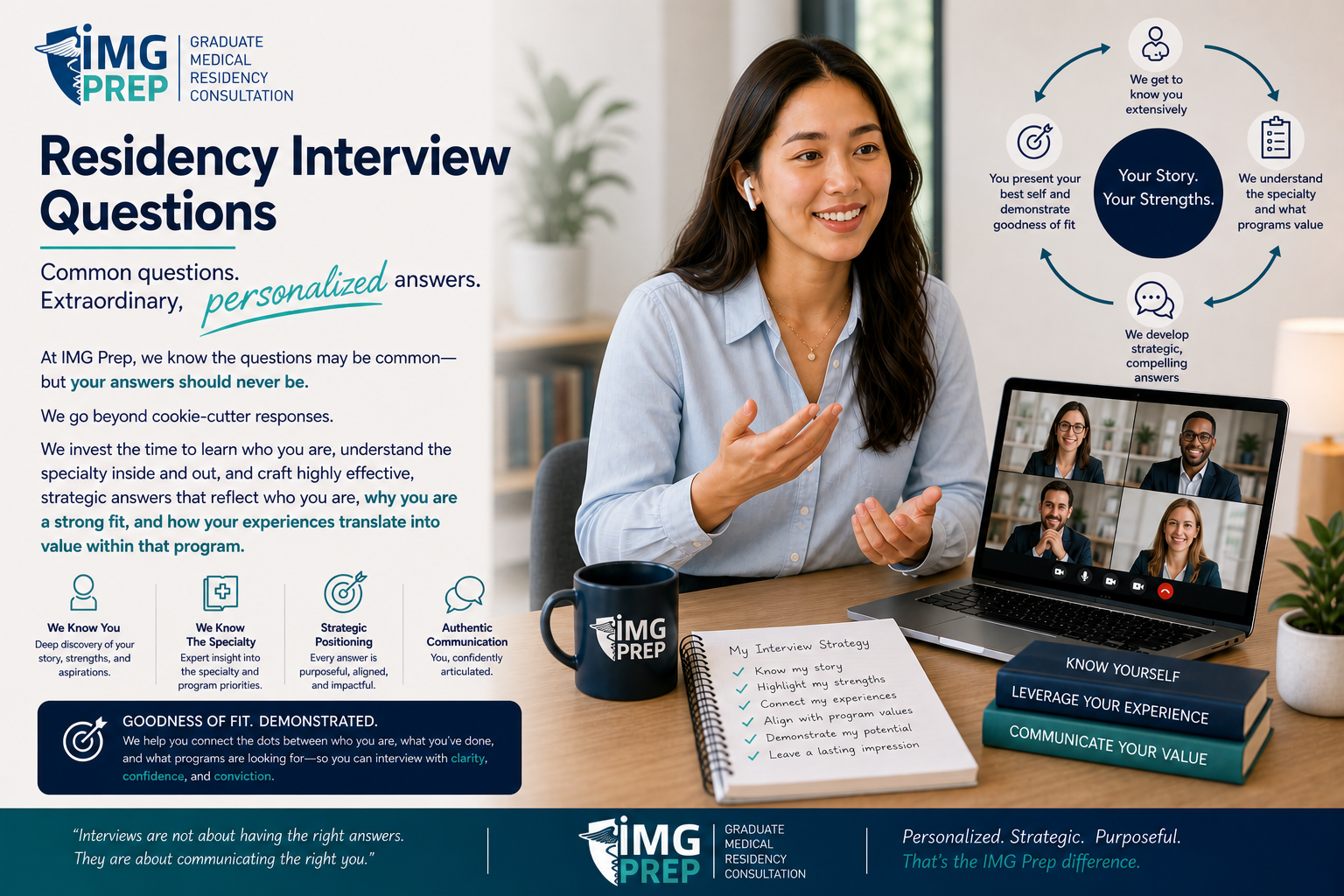
Individualized Residency Interview Preparation
Within the IMGPrep Diagnostic Reasoning Model, residency interviews function as the stage in which programs test the working assumption of fit formed during holistic review. Effective preparation begins with a careful examination of the applicant’s own application — the most persuasive interview responses are already embedded within the experiences, motivations, and professional identity documented there. IMGPrep conducts one-to-one interview preparation only after a full review of ERAS materials.
Related Reading on imgprep.com
- → IMGPrep Residency Interview Preparation Service
- → Standardized Screening vs. Holistic Review in Residency Selection
- → MSPE for IMGs: Strategic Guide to the Medical Student Performance Evaluation
- → IMG Friendly Programs and the SUVY Framework
- → Five-Year Analysis: IMG Residency Match Statistics, 2022–2026
- → Browse All IMGPrep Articles
Sources
- Strausser 2024 — Program Director Survey
- Angus 2020 — Screening practices
- Gordon 2020 — Interview interpretation study
- Hahn 2023 — Rank order predictors
- Boatright 2023 — Holistic review / mission alignment
- Habashy 2024 — Neurosurgery match survey
- Mieczkowski 2025 — Holistic review rubric
- Gong 1984 — Interview influence study
IMGPrep is not associated with the NRMP®, the MATCH®, the ECFMG®, the AAMC, or any specialty board.
Contact Us
IMGPrep LLC, 4000 Legato Rd. Suite 1100
Fairfax, VA 22033
Fairfax, VA 22033
Fax: +1 (202) 751-2590