The IMGPrep Tem™ Framework
IMG Friendly Residency Programs for IMGs
Selectivity is structural.
The list you apply to decides the rest.
IMG friendly residency programs are not identified by self-description. The pattern is behavioral — observable in a program’s prior match list, filterable against your candidacy, and the precondition for a goodness-of-fit match.
Build My Customized Programs List → How the framework works ↓The Framework
IMG friendly residency programs: a pattern in the match list, not a promise on the website.
An IMG friendly residency program is one whose director has, across prior cycles, demonstrated willingness to interview and rank International Medical Graduates given the program’s posted minimums for USMLE scores, U.S. clinical experience, visa sponsorship, and years from graduation. It is not a self-described designation. It is a behavioral pattern observable in the program’s prior match list.
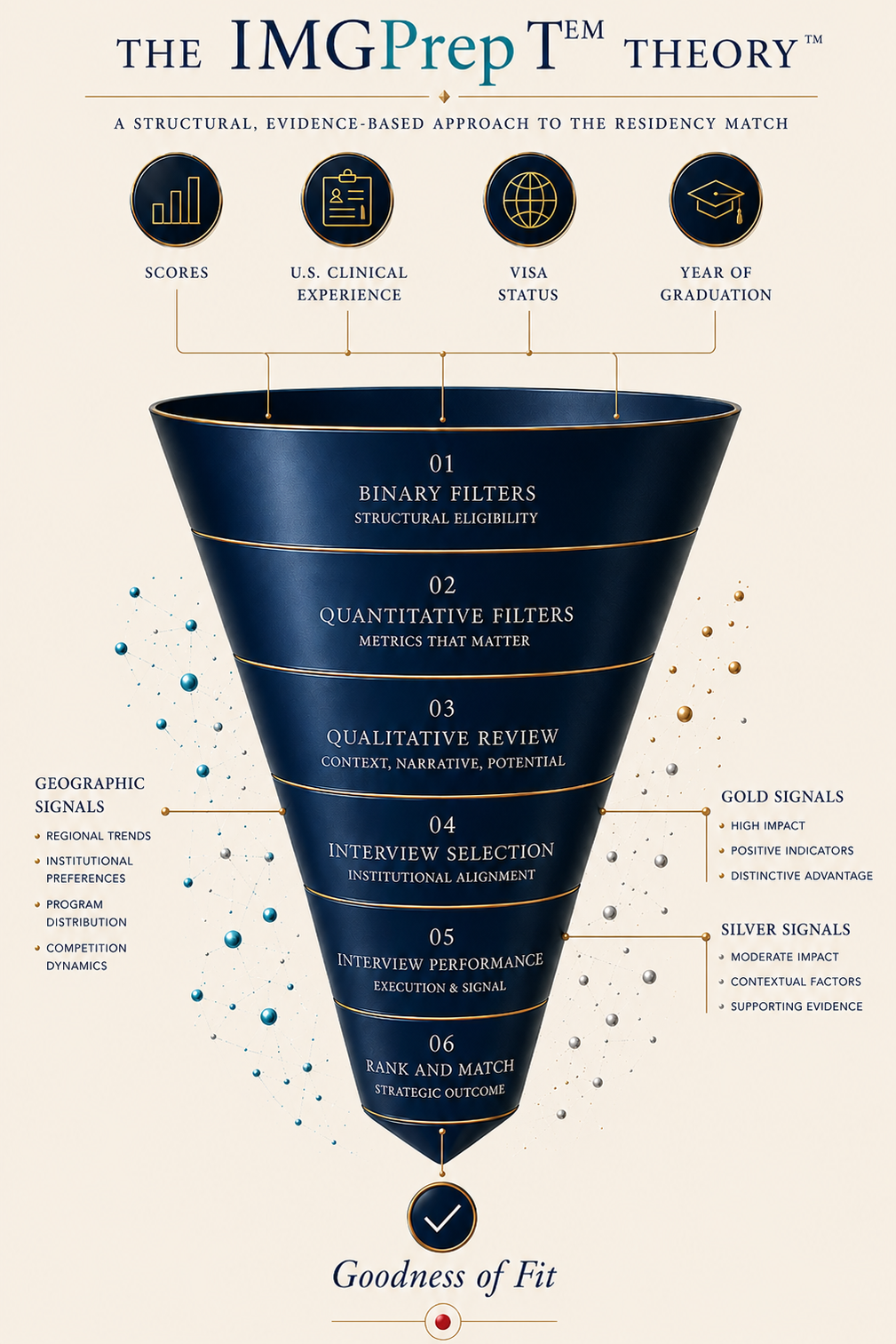
In the IMGPrep Tem™ — The Equitable Match — framework, “IMG friendly” lives at the intersection of the binary and quantitative filter stages. It is the structural screen each application passes through before any human reviewer reads a personal statement.
Within this funnel, the question “is this program IMG friendly?” reduces to four narrower questions about how an application clears the structural screen at Stages 01 and 02. Stages 03 through 06 cannot occur until those filters have cleared.
Your list is the single highest-leverage decision in this funnel. Everything downstream is downstream of it.
Figure 1. The IMGPrep Tem™ — The Equitable Match. Six sequential stages. Every application traverses all of them, in order. Program signals and geographic signals exert their force at Stage 04, where programs decide which qualified applications convert to interview invitations.
Build My Customized Programs List →Figure 01 — The Match Funnel
The Four Structural Filters
SUVY.
Four structural filters every program applies before holistic review. Clear all four, or be screened out at intake.
01
Scores
USMLE Step 2 CK is now the dominant quantitative filter, following Step 1’s transition to pass/fail. Step 3 strengthens visa-sponsored applications meaningfully; for some programs it is the swing variable that converts a screen-out into a review.
02
U.S. Clinical Experience
Hours of hands-on USCE in ACGME-equivalent settings, weighted toward inpatient experience and recency. The filter is not just total hours; it is the quality and timing of those hours relative to the application year.
03
Visa Status
H1B, J1, or no sponsorship needed. Programs publicly disclose which they accept. The 2026 Match data confirms this is the highest-impact single filter in the entire funnel. A list built without filtering on visa status is not filtered.
04
Year of Graduation
Years from medical school graduation. Most programs publish a maximum, commonly three to five years. Beyond it, applications are screened out at intake. Recent Step 2 CK and recent USCE can mitigate the filter at some programs but not all.
IMGPrep’s Customized Residency Programs List operationalizes SUVY against every ACGME-accredited program in your specialty, using a database we have maintained and refined since 2005.
The 2026 Structural Gap
In 2026, visa status became the most expensive variable in the application.
The 2026 Main Residency Match results, released by NRMP on March 20, 2026, included for the first time a disclosure of the match rate split within non-U.S. citizen IMGs by visa sponsorship requirement.
U.S. Permanent Residents
67.9%
2026 match rate — a five-year high
Visa-Sponsored Applicants
54.4%
2026 match rate — a five-year low
The Structural Gap
13.5 pp
The empirical price of needing visa sponsorship.
Two applicants with identical USMLE scores, identical USCE hours, and identical years from graduation now face a different structural reality at the same specialty based on whether the program needs to sponsor a visa.
If you need visa sponsorship, the list you apply to is no longer a strategic preference. It is the variable.
Stage 04 — Interview Selection
Signals decide which qualified applications become interviews.
92%
of programs reported using program signals to determine whom to invite to interview in the 2025 ERAS season. Signals rank in the top five application components by program director importance.
Once Stages 01 through 03 have cleared, programs face a pile of qualified applications larger than their interview capacity. Two applicant-controlled inputs in ERAS shape which of those qualified applications convert to invitations.
Program signals.
Tokens an applicant attaches to specific programs to indicate genuine interest. Signal counts vary by specialty: Small Signal specialties (Internal Medicine, Family Medicine, Pediatrics, Emergency Medicine) issue few; Large Signal specialties (Orthopedics, Otolaryngology) issue many; Tiered specialties (Dermatology, OBGYN) distinguish Gold signals — most preferred — from Silver signals — preferred.
AAMC research has found that, on average, IMG and DO applicants send fewer signals than their MD peers. A tool that 92% of programs use to decide interview invitations is the wrong tool to under-utilize.
Geographic signals.
ERAS divides the U.S. into 9 geographic regions; applicants may select up to 3 preferred regions and provide a 300-character explanation. Programs in selected regions see the preference. Signaling a program outside your stated geographic region is documented to weaken the signal’s impact — the two systems interact, and incongruent signals read as low intent.
The Cost of an Unfiltered List
Fees that scale with the volume of your uncertainty.
Most IMG applicants apply to 100 or more programs per specialty because they are hedging against uncertainty. A filtered list converts that uncertainty into precision and reduces the application volume needed without reducing match probability.
The 2026 Fee Structure
AAMC restructured the ERAS fee model beginning with the 2025 season. The simplified rate is in effect for the 2026 cycle (June 4, 2025 through May 31, 2026). The structure is per-specialty — every additional specialty resets the count.
Programs 1–30 per specialty
$11 each
Programs 31+ per specialty
$30 each
A filtered list typically reduces application volume by 30 to 40 percent with no loss of match probability. A 100-program Internal Medicine application costs $2,430 in ERAS fees alone — filtering saves $900 to $1,200 before USCE, interview travel, or visa costs.
ERAS Calculator
Your 2026 ERAS Cost
Enter program counts above
Estimated total
$80
Source: AAMC, Fees for ERAS Residency Applications, 2026 season.
Strategic Match Consulting Since 2005
Do not build the application before you build the list.
A defensible list of IMG friendly residency programs takes two readings. A structural screen of your SUVY profile, then an interpretive read of each program’s match behavior — peer-school clustering, alumni trails, IMG composition split, fellowship architecture. In Internal Medicine: 707 programs read against your signature.
IMGPrep’s Customized Programs List runs both — algorithmic screen, recognition layer calibrated by over two decades of analysis and reasoning. The output is not a list of programs that take IMGs — it is a list of programs where recognition has the highest probability of occurring for your profile.
Every program carries a fit lock score and verified data, timestamped by last verification.
The List is upstream of everything — clinical experiences, ERAS strategy, document development, interview preparation. One integrated match strategy.
Build My Customized Programs List →Contact Us
IMGPrep LLC, 4000 Legato Rd. Suite 1100
Fairfax, VA 22033
Fairfax, VA 22033
Fax: +1 (202) 751-2590