Five Year Analysis IMG Residency Match Statistics for 2021-2026
April 21, 2026



The Residency Match Is Not Random — It Is Predictable
A Data-Driven Interpretation of the 2026 NRMP Match
Hey — look at this.
Seriously. Before we go anywhere, sit with these numbers for a second.
Everyone talks about how competitive the Match is getting. How the rules keep shifting. How it feels like a moving target. But when you actually sit down and read the IMG residency match statistics from 2022 through 2026, something very different comes into focus.
The numbers have stabilized.
The Match isn’t chaotic. It isn’t unpredictable. It isn’t swinging wildly from year to year. It is — and this is the part almost nobody says out loud — remarkably consistent. And for International Medical Graduates, that consistency is genuinely good news.
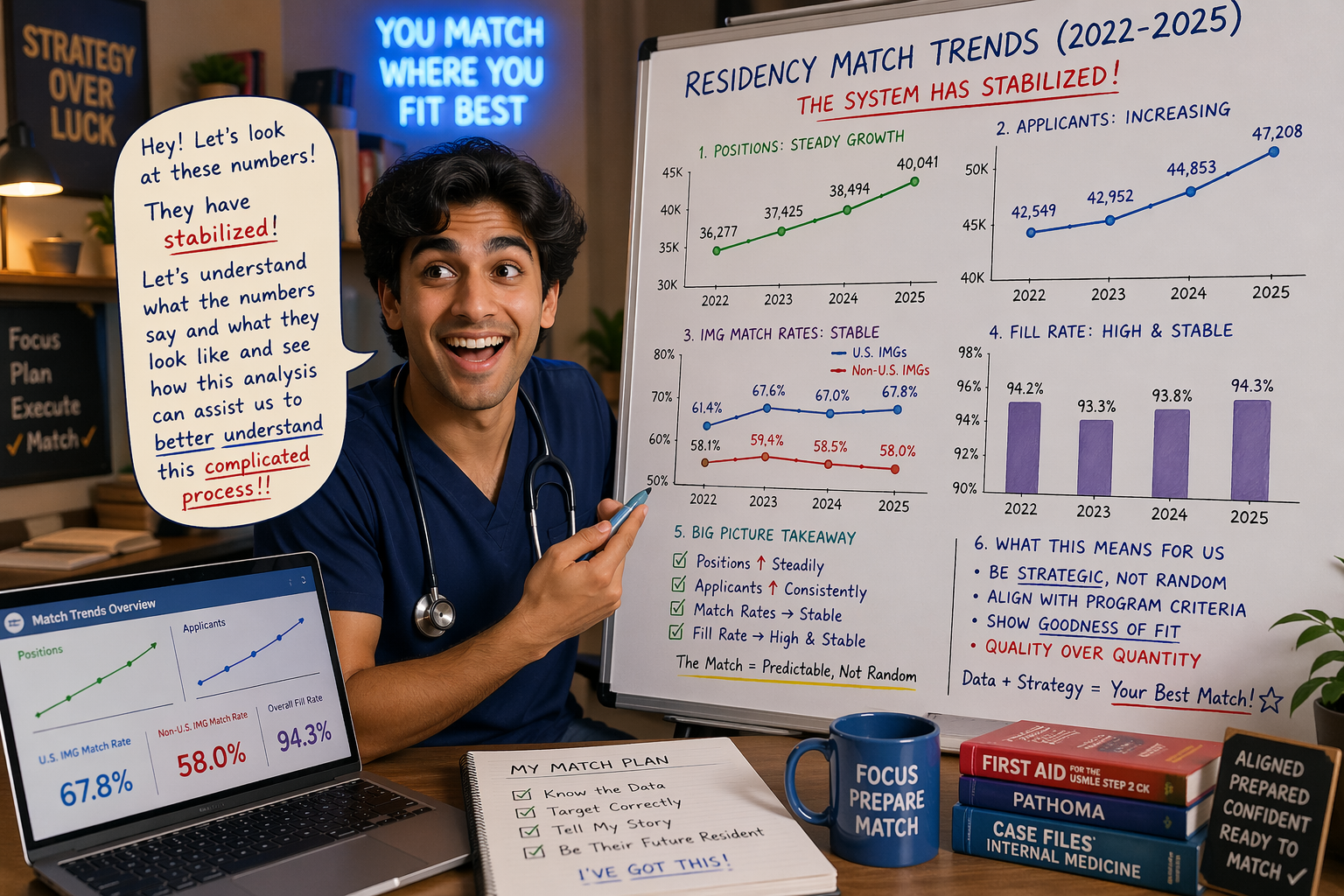
Once something becomes consistent, it becomes strategic.
That’s what this article is going to walk you through. Five years of NRMP data, five charts, and a reframe that changes how you should think about your application — especially given the new findings released in the 2026 Main Residency Match results.
Let’s go.
Look at the System First
Here’s the first thing.
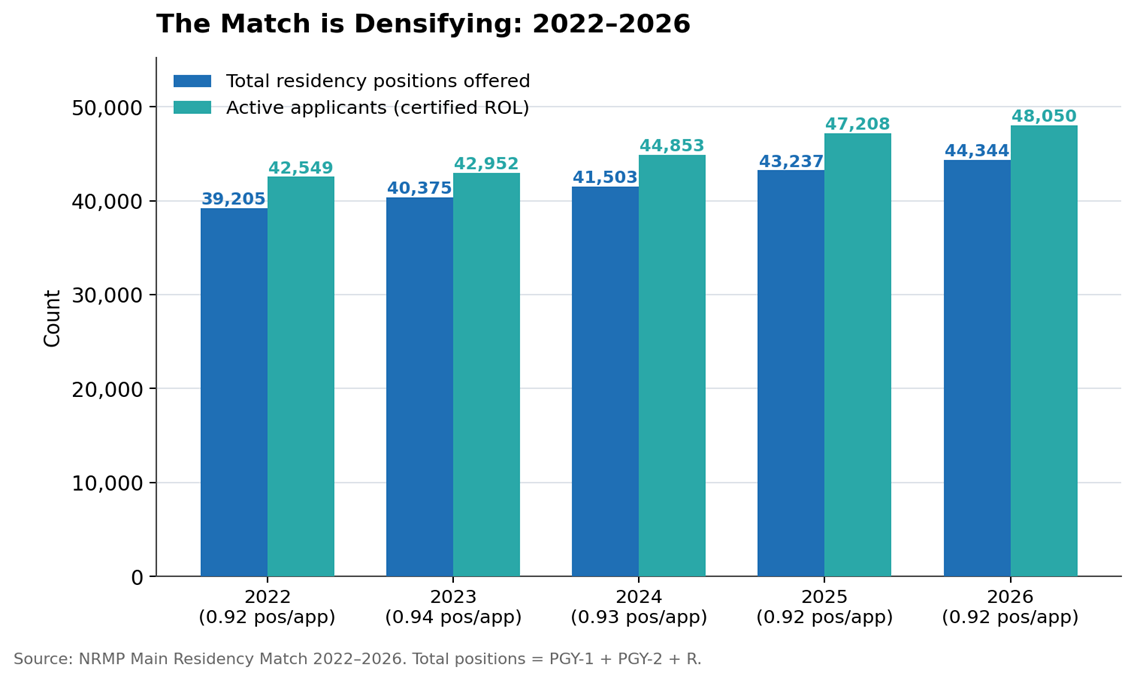 Figure 1. Total residency positions vs active applicants, 2022–2026. Source: NRMP.
Every year, more positions. Every year, more applicants. And the ratio between them — positions per applicant — has held in a tight band between 0.92 and 0.94 for five years straight.
That is not an accident. That is a system with capacity being added intentionally, at a pace that matches demand. Growth is controlled. Linear. Predictable.
The 2026 Main Residency Match was the largest in NRMP history — over 44,000 positions, more than 53,000 applicants registered, 6,809 program tracks. And the ratio didn’t break. Supply and demand grew together. That tells you the system has an equilibrium it is actively maintaining.
Here’s why this is good news for you: when a system is in equilibrium, it becomes transparent. Programs rely on clear, measurable criteria — USMLE scores, year of graduation, visa status, U.S. clinical experience. Those criteria are visible. Which means you can prepare for them. Which means outcomes become something you can actually influence.
The Match isn’t spinning out of control. It’s tightening around structure. And structure is something strategy can work with.
Now Watch What Happens to Match Rates
Here’s where it gets interesting — and where the news for U.S. citizen IMGs is genuinely outstanding.
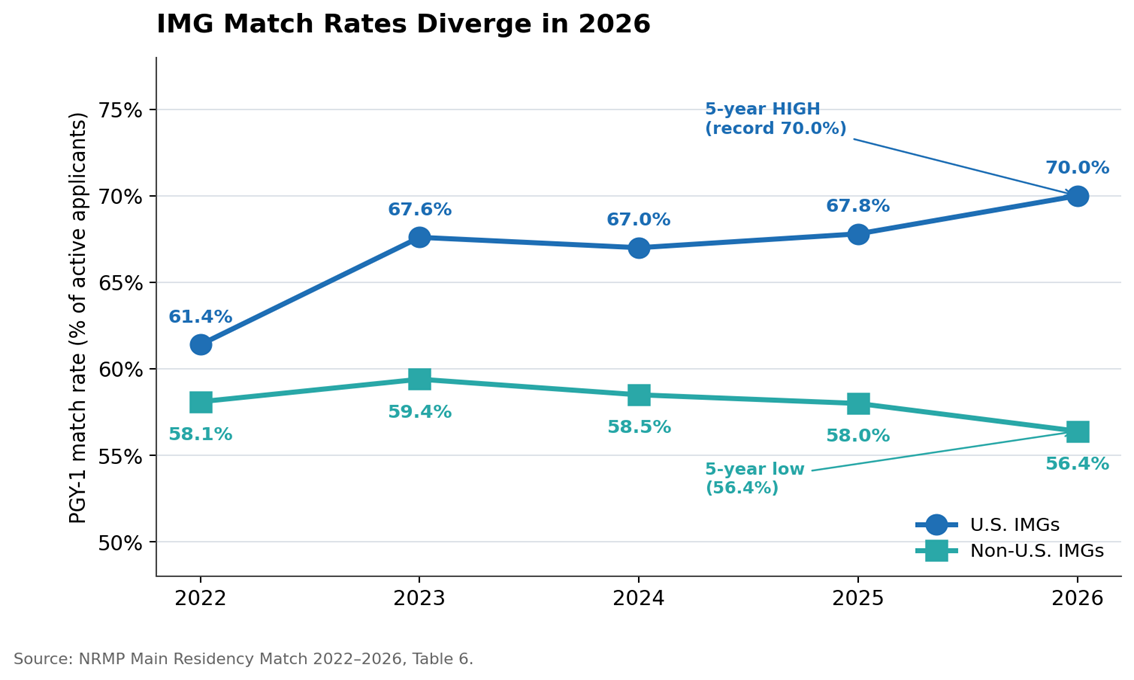 Figure 2. PGY-1 match rates for U.S. and non-U.S. IMGs, 2022–2026. Source: NRMP Table 6.
U.S. IMGs had their best year on record in 2026. 61.4% in 2022. Then 67.6%. Then 67.0%. Then 67.8%. Then 70.0% in 2026 — an all-time high. That’s not a blip. That’s a five-year trajectory of a pathway that keeps getting stronger for the applicants who pursue it.
Non-U.S. IMGs, as an aggregate group, went in the other direction: 58.1%, 59.4%, 58.5%, 58.0%, and then 56.4% in 2026. But that aggregate number is hiding a much more specific story — and once you break it apart, it becomes something you can actually plan around.
This divergence is the heart of the 2026 data, and it’s why the broad headline numbers don’t tell you what you actually need to know. Let’s look at what’s really driving it.
This Is the Big One
For the first time ever, the NRMP broke out non-U.S. IMG match rates by visa sponsorship status. Here’s what they found.
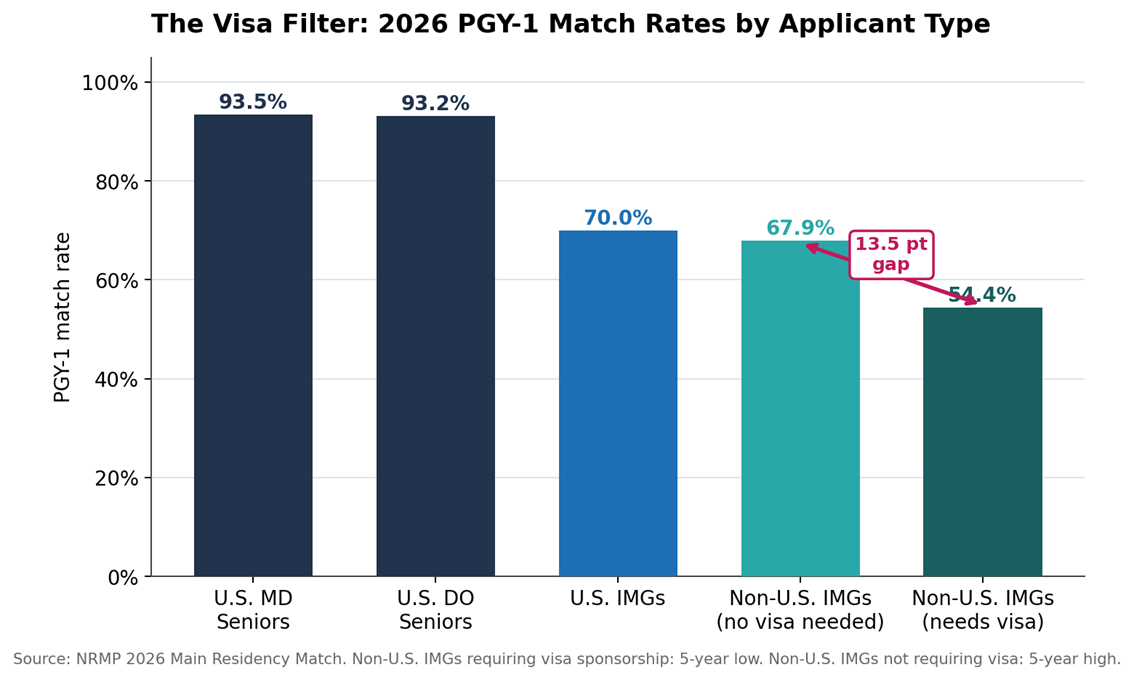 Figure 3. 2026 PGY-1 match rates by applicant type. The 13.5-point gap inside non-U.S. IMGs is driven by visa sponsorship status alone. Source: NRMP 2026.
Non-U.S. IMGs who are U.S. permanent residents — not needing visa sponsorship — matched at 67.9%. A five-year high.
Same group of applicants, but requiring J-1 or H-1B visa sponsorship: 54.4%. A five-year low.
13.5 percentage points. One variable. Visa status.
Same medical school type. Same ECFMG certification pathway. Same USMLE track. Often comparable scores and experience. The only structural difference — visa status — is now producing a 13.5-point gap in match outcomes. That is not noise. That is a first-order binary filter operating at scale across the system.
The NRMP itself flagged federal immigration policy changes as the likely driver. Programs that previously sponsored visas have tightened their sponsorship policies; programs that never sponsored haven’t reversed course. The result is that a larger share of residency positions are effectively closed to applicants who need sponsorship — regardless of how competitive those applicants are academically.
Two important notes:
- If you’re a U.S. citizen IMG, this filter doesn’t apply to you. Your pathway has essentially no visa layer. That’s part of why your group’s match rate keeps climbing.
- If you need visa sponsorship, this changes the strategy — not the possibility. 6,733 non-U.S. IMGs still matched in 2026, a record absolute high. The programs that actively sponsor are still actively sponsoring. The work is about identifying them precisely and building your application around what they actually select for.
The Two Pools Tell Different Stories
Layered on top of the visa story is a broader shift in who’s applying. And for U.S. citizen IMGs specifically, this is where the picture gets genuinely encouraging.
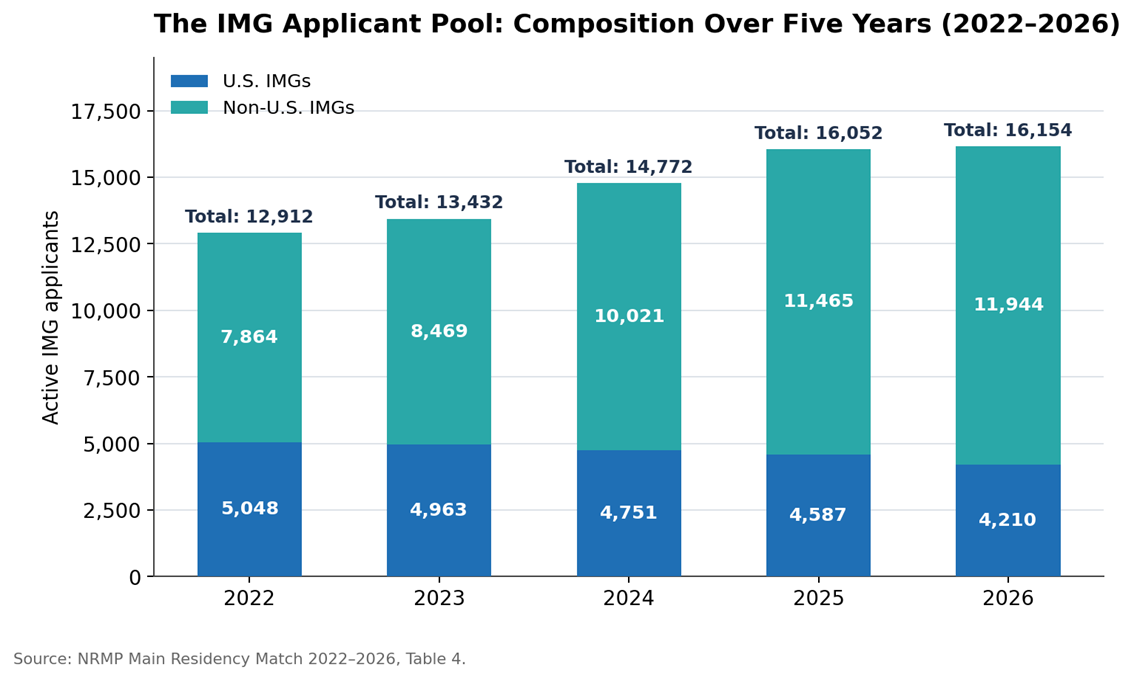 Figure 4. Active IMG applicants by citizenship, 2022–2026. Source: NRMP Table 4.
If you’re a U.S. citizen IMG, look at what this actually means. The U.S. IMG pool has become more focused over five years — 4,210 active applicants in 2026, compared to 5,048 in 2022. Fewer total competitors. More total positions in the system. And a match rate that climbed to 70.0% — a record high. Put those together and the math is simple: the U.S. IMG pathway is rewarding the applicants who commit to it more than it ever has.
This isn’t a pathway in decline. It’s a pathway that’s been filtering itself, and the applicants who show up prepared are succeeding at a rate that would have looked impossible a decade ago.
For non-U.S. IMGs, the composition story is different. The pool grew from 7,864 in 2022 to 11,944 in 2026 — a 51.9% increase. More applicants competing for the same visa-sponsoring programs. That’s what concentrates the pressure we talked about in the last section. And it’s why precise program selection matters more every year.
In total, 9,682 IMGs matched in 2026 — 2,949 U.S. IMGs and 6,733 non-U.S. IMGs. That’s 23.6% of all matched applicants. IMGs remain an essential part of the U.S. physician workforce. The structural conditions for matching have shifted. The path is still absolutely there.
Now Look at the One Nobody Talks About
Ready for the number that should make you less anxious, not more?
The overall position fill rate. Year by year:
- 2022: 94.2%
- 2023: 93.3%
- 2024: 93.8%
- 2025: 94.3%
- 2026: 93.5%
One point of variance across five cycles. One.
Think about what that means. Through applicant growth, specialty expansion, pandemic recovery, immigration policy change, and every other variable social media blames for making the Match “feel chaotic” — the system is filling its seats with the consistency of a well-calibrated machine.
Positions offered find applicants. Applicants find programs. Programs fill their classes. Year after year. Regardless of what anyone is saying in January.
A system this stable is a plannable system. You can build strategy against it.
You cannot build strategy against chaos. You can absolutely build strategy against a 93.5% fill rate that has held within one percentage point for five years.
Which means the Match isn’t a lottery, and it isn’t a machine designed to reject you. It’s an algorithm doing what algorithms do — taking structured inputs from both sides and producing the most efficient matching it can. The IMG residency match statistics in this section aren’t a scary number. They’re a promise: if your application fits somewhere, the system is designed to find that fit.
Your job as an applicant is to make sure your inputs to that algorithm are aligned with the programs most likely to match you.
Where IMGs Actually Match
Let’s look at where the matches are happening.
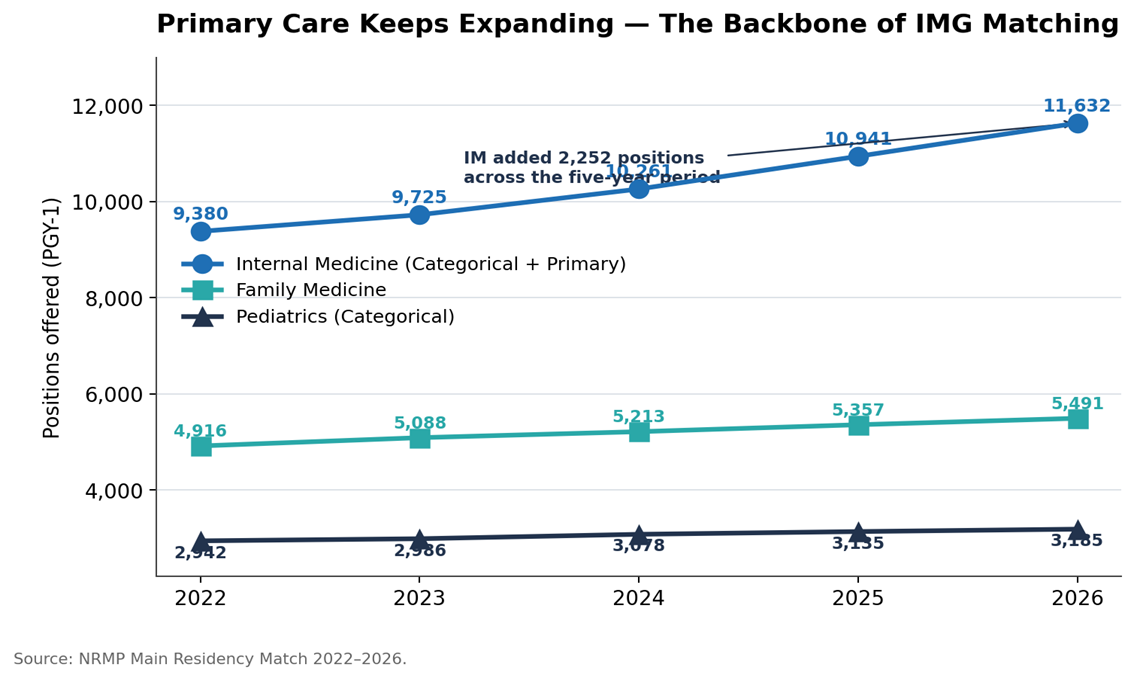 Figure 5. PGY-1 positions offered in primary care specialties, 2022–2026. Source: NRMP.
Internal Medicine. Family Medicine. Pediatrics. Every year, these three specialties expand. Every year, they represent the highest-volume entry points for IMG applicants.
Internal Medicine alone grew from 9,380 positions in 2022 to 11,632 in 2026 — an additional 2,252 seats in five years. In 2026, Internal Medicine matched over 4,800 IMGs. Family Medicine matched over 1,300 more, and Pediatrics matched nearly 900. Together, those three specialties account for the majority of all IMG matches.
Beyond the primary care backbone, several specialties have become meaningful pathways for IMGs as well. Emergency Medicine has stabilized strongly after pandemic-era turbulence — a record-high U.S. IMG match year, with 315 U.S. IMG matches in 2025 alone, and continues to grow as a primary EM strategic option for U.S. citizen IMGs in particular. Psychiatry added 481 new positions across four cycles (a 25% increase) and continues a steady upward trajectory in IMG matches. And Neurology remains a consistent top-five entry point for non-U.S. IMGs, with structural recruitment patterns that reward specialty-aligned applications.
This isn’t a suggestion to pick primary care because it’s “easier.” Nothing in the Match is easier. It’s a structural observation: these are the specialties where programs have built real infrastructure to evaluate and train IMG residents. For applicants with genuine interest in primary care, the structural receptivity of these fields is an asset worth understanding — not a consolation prize.
And Here’s the Pattern Nobody Talks About
This next point is the one I want you to really sit with, because it’s been true for more than two decades and it changes everything about how you should think about your application.
Matched applicants consistently rank more programs. Every single year. For over twenty years.
NRMP’s own Charting Outcomes data has shown this pattern consistently across every applicant type and every specialty. The more programs you rank, the higher your match probability. Not linearly up to infinity — but substantially, and reliably, across the meaningful range.
Why? Because the algorithm is designed to find goodness of fit. If you give the system more chances to find your match, it finds more matches. It is literally that simple. The math of the algorithm rewards precisely-ranked, well-matched lists — and rewards longer well-matched lists even more.
So the question isn’t just do I have strong scores, or is my CV good enough. Those matter. But they are inputs. The real question is whether you’re navigating the system with enough precision — enough program-level fit — to give the algorithm the raw material it needs.
Success isn’t just about your credentials. It’s about how you move through the system.
So Stop Asking the Wrong Question
Here’s the reframe. It’s going to feel obvious once I say it, but almost every applicant starts in the wrong place.
The question most IMGs walk into the Match asking is:
Am I competitive enough?
That’s the wrong question.
The right question — the one the data has been telling you to ask for the entire length of this article — is:
Am I positioned correctly within a system that already knows exactly how it selects applicants?
Because if the system is stable — and it clearly is — then outcomes are not random. They’re patterned. They’re reproducible. Which means they can be optimized.
You are no longer just applying.
You are making decisions with intent.
What “Selection” Actually Means Now
And here’s where the language itself is changing — because the old vocabulary was causing real confusion.
For years, GME leaders talked about holistic review as the stage where programs look at the whole application beyond scores. That framing made sense, but it was always too vague to be actionable. What is the whole application? Whose whole application? Whole, according to what criteria?
Increasingly, programs and GME leaders are describing this stage more precisely as mission-aligned selection and retention. The difference matters.
Holistic review suggested programs look at everything. Mission-aligned selection is more specific: programs are looking for applicants whose profile, values, and trajectory align with their institutional mission — the kind of physicians that program is actually designed to train, graduate, and retain in practice.
Some programs’ missions are academic research and subspecialty pipelines. Some are rural and underserved care. Some are community-based primary care. Some are specific populations, specific workforce gaps. Each mission shapes its selection criteria.
Which means — and this is the part that changes everything about how you should build your application — there’s no such thing as a universally strong application. There is only a strong application for this specific program’s mission.
A candidate who is moderately competitive on paper but precisely mission-aligned with a given program can out-match a candidate with stronger scores whose profile doesn’t match. And over a rank list of 15 or 20 or 30 programs, those alignments compound. That’s the math of the algorithm. That’s why matched applicants rank more programs — because the ones who understand the system are applying with precision, not volume.
This Is Where IMGPrep Actually Comes In
So let’s tie it all together.
The Match is stable. The funnel is predictable. U.S. IMG match rates are at an all-time high. The non-U.S. IMG pathway is still open, but visa sponsorship has become a decisive filter that requires precise program-level strategy. The rank-more-programs pattern has held for two decades. Mission-aligned selection is the game being played at the program level.
And outcomes for every IMG applicant — U.S. citizen, non-U.S. citizen, permanent resident, visa-required — are determined by how precisely each applicant positions themselves within all of this.
That’s not something you can solve with a template. It’s not something you can solve by filling out a form. It requires structured, evidence-based work on your specific profile against the specific programs whose missions align with who you are and where you’re going.
That’s exactly what IMGPrep Residency Match Consulting is built to do.
We’ve been doing this work for 20 years — studying how individual programs actually select their residents. Not generic Match advice. Not one-size-fits-all checklists. Program-level mission analysis. SUVY-based profile evaluation. Gap identification. Long-term trajectory planning when profiles need time to develop. The kind of work that takes a candidate from hopeful applicant to precisely positioned applicant.
What Consulting Actually Does for an IMG Applicant
Profile evaluation against current program-level selection patterns — not general benchmarks, but the actual patterns of the programs you’re targeting.
Gap analysis using the SUVY framework (Scores, U.S. Clinical Experience, Visa, Year of Graduation) to identify exactly where your application is strong, exactly where it’s filtered, and exactly what has the highest return on investment to change.
Mission-aligned program strategy — building a list that reflects the programs whose actual institutional missions match your trajectory, not just programs that accept IMGs.
Strategic timing and long-term profile development — helping applicants build their SUVY profile and U.S. clinical footprint to full competitive strength before entering the Match. The goal is to apply at your strongest, not your fastest.
Consulting works in tandem with the rest of the IMGPrep suite — USCE rotations when you need hands-on exposure and letters that carry weight, ERAS Document Services when your written application needs to demonstrate alignment with specific program missions, Interview Preparation for converting interview invitations into rank-list placement, and the Customized Residency Program List as the data infrastructure underneath all of it. But consulting is the strategic layer that ties the whole thing together.
Ready to apply with intent?
The data is clear. The Match is a stable, predictable, patterned system. Your outcome in it will be determined by how precisely you’re positioned — not by luck, not by how hard you work in isolation, and not by how many programs you apply to without a strategy.
IMGPrep Residency Match Consulting is where precision happens. 20 years of evidence-based advisory work with IMG candidates, grounded in the same data you just read about. Let’s sit down and figure out exactly where you are in the funnel, exactly what the programs you’re targeting are actually selecting for, and exactly what your application needs to look like to get there.
Schedule a Residency Match Consulting call →Not quite ready for a consulting conversation? Start with a Customized Residency Program List to see where your current SUVY profile puts you, read our companion analysis on IMG-Friendly Residency Programs for 2026, or browse more articles in the IMGPrep library to keep building your understanding of the system.
Whichever way you start — start. The 2027 cycle is already in motion.
Data sources: NRMP Results and Data reports for the 2022, 2023, 2024, and 2025 Main Residency Match and the 2026 Main Residency Match Advance Data Tables, available at nrmp.org. NRMP Charting Outcomes in the Match reports inform the long-term ranking-behavior pattern referenced in this article. Match Rate = matched PGY-1 applicants divided by active applicants. The visa sponsorship breakdown for non-U.S. IMGs was first disclosed by NRMP in the 2026 Main Residency Match announcement. IMGPrep is not associated with the NRMP, the Match, or ECFMG/Intealth.
Further reading: NRMP Match Data | NRMP 2026 Main Residency Match Results | Intealth EVSP | ACGME
Contact Us
IMGPrep LLC, 4000 Legato Rd. Suite 1100
Fairfax, VA 22033
Fairfax, VA 22033
Fax: +1 (202) 751-2590