DO Friendly Residency Programs: Matching in Internal Medicine for Osteopathic Candidates
January 11, 2026



Introduction: DO Friendly Residency Programs
IMGPrep Strategic Analysis · DO Match Strategy · 2026 NRMP Data
DO friendly residency programs — programs in which osteopathic graduates make up a meaningful share of the resident class — are the structural foundation of a strong DO Match strategy. The 2026 Main Residency Match closed with 7,928 DO Seniors matched at a 93.2 percent match rate, the highest in NRMP history. The programs driving these outcomes can be identified in advance, and applying to them strategically is the single highest-leverage move available to a DO applicant.
Why DO friendly residency programs matter
Programs that match DOs at scale have demonstrated, through revealed preference, that they evaluate osteopathic applicants on holistic merit rather than allopathic accreditation alone. For DO students applying this cycle, identifying these programs in advance — and concentrating application effort there — is more strategically valuable than chasing program prestige rankings.
DO Senior match performance
93.2%
2026 DO Senior Match Rate
A five-year high
A five-year high
Five-year trend — DO Senior match rate
91.3%
2022
91.6%
2023
92.3%
2024
92.6%
2025
93.2%
2026
Source: NRMP Advance Data Tables 2026, Table 4. DO Senior match rates have improved every year since 2022.
The 2026 Main Residency Match closed on March 20, 2026 with the strongest DO Senior performance in NRMP history. Of the 8,503 DO Seniors who submitted certified rank order lists, 7,928 matched to PGY-1 positions — a match rate of 93.2 percent, up from 91.3 percent in 2022. Match rates have improved every single year for five consecutive years, even as the DO applicant pool grew by more than 16 percent. The system has absorbed more DOs at higher rates simultaneously, which is the clearest possible signal that DO friendly residency programs have institutionalized osteopathic selection rather than treating it as exceptional.
For a DO student applying this cycle, the strategic question is not whether DO friendly residency programs exist — the data establishes they do. The strategic question is which programs qualify, in which specialties, with which selection criteria. That identification is what determines whether application effort produces interview signal proportional to your USMLE/COMLEX profile, or whether it gets absorbed by programs whose stated DO openness does not match their actual match composition.
What Defines a DO Friendly Residency Program
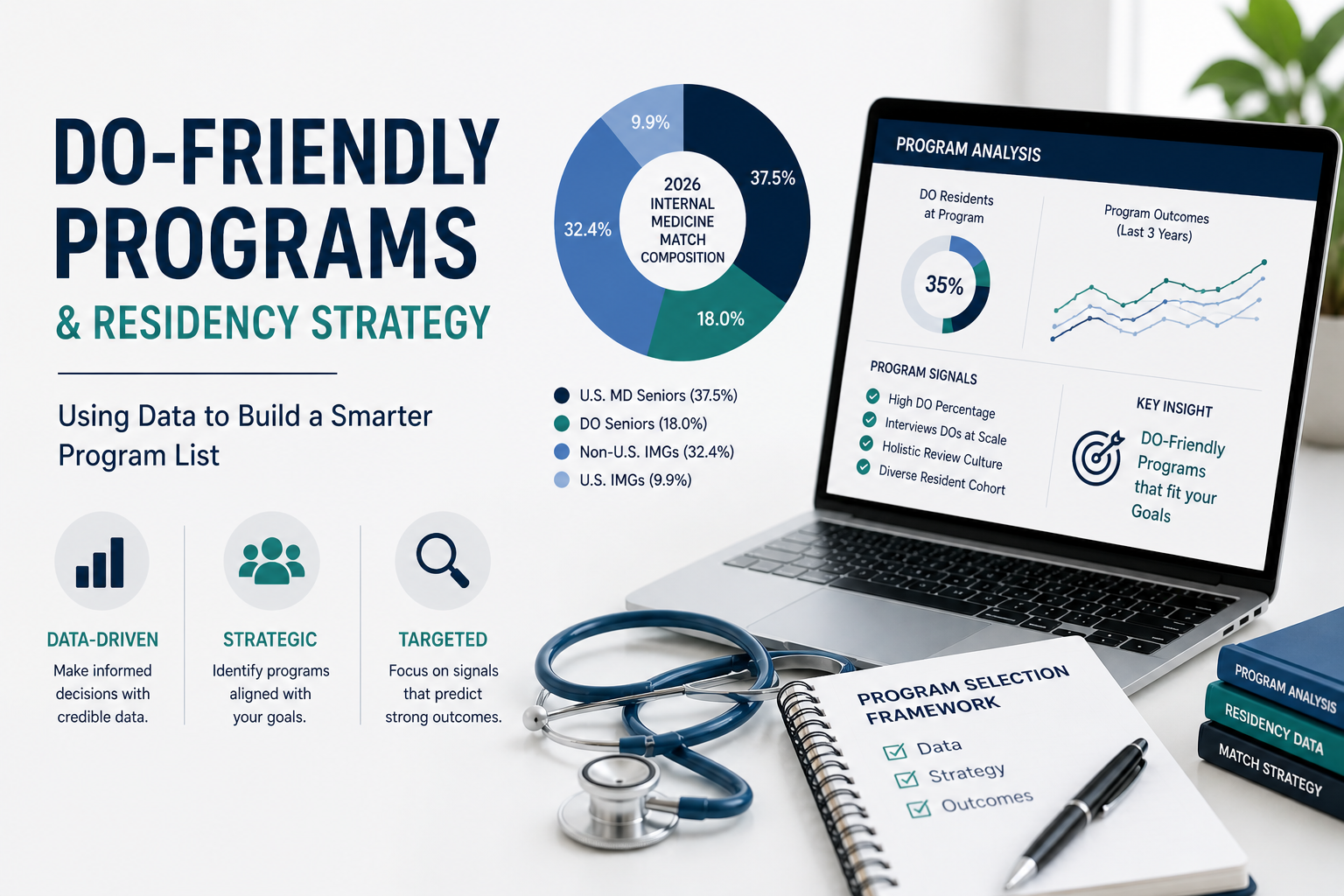
A DO friendly residency program is one that has demonstrated, through its actual matched resident composition, a willingness to interview and rank graduates of U.S. osteopathic medical schools at meaningful scale. The standard threshold used by program list services is 25 percent or more DO residents in recent matched cohorts — meaningfully above the 18.0 percent national average for Internal Medicine in 2026.
The distinction matters because stated DO openness and revealed DO openness are not the same thing. Many programs publish language welcoming osteopathic applicants without ever ranking them at scale. Other programs that publish nothing specific to DOs have built quietly diverse training cohorts in which DO Seniors form a stable portion of every incoming class. Match composition data — what the program actually did in recent years — is the only reliable measure.
Programs that qualify as DO friendly residency programs share four observable characteristics:
- Their application screening process does not filter out osteopathic candidates by default. Filters that drop COMLEX-only applicants or that screen exclusively on USMD-style metrics functionally exclude DOs even when programs do not state this policy explicitly.
- Their faculty have demonstrated capacity to evaluate osteopathic training. The single accreditation transition that completed in 2020 normalized this at the institutional level, but individual program implementation varies substantially.
- Their residency culture supports osteopathic training tradition. Programs that work for DOs often (though not always) have current osteopathic faculty, OMT integration in clinical training, or institutional history of osteopathic affiliation.
- Their leadership has explicitly approved DO selection as part of training strategy. Match composition reflects rank list decisions; high DO percentages mean DOs are being ranked, not just interviewed and dropped.
DO Friendly Residency Programs in Internal Medicine: 2026 Data
Internal Medicine is the largest single specialty for DO Seniors, accounting for 1,914 of the 7,928 DO Senior matches in 2026 — about 24 percent of all matched DO Seniors. The competitive landscape inside IM is favorable for DOs: 10,657 IM PGY-1 positions filled in 2026, of which DO Seniors accounted for 18.0 percent. That ratio has held stable above 17 percent every year since 2022, indicating structural absorption rather than a single-year fluctuation.
Three observations matter for DO students building an Internal Medicine residency strategy. First, match rates rose every year while the applicant pool grew. Programs are choosing to take more DOs at higher rates, not being forced to as the pool expanded. Second, DO Senior IM placement is structurally established — 18.0 percent of IM PGY-1 in 2026 means roughly one in every 5.5 IM residents is a DO Senior. Third, the gap between DO and MD Senior match rates is narrowing. MD Seniors matched at 93.5 percent in 2026; DO Seniors matched at 93.2 percent — a gap of 0.3 percentage points, the smallest in NRMP history.
Identifying DO Friendly Residency Programs in Practice
National-level DO match data establishes that DO friendly residency programs exist and absorb DOs at scale. It does not identify which specific programs qualify. That identification requires program-level data: matched resident composition by graduation school, DO percentage of recent classes, COMLEX-only acceptance status, OMT integration in training, and program-specific filtering thresholds.
For DO students working through this in real time, several signal sources are practically useful:
- Program websites — current resident pages. Many IM programs publish current resident bios with medical school affiliation. Counting DO graduates across PGY-1, PGY-2, and PGY-3 gives a three-year snapshot of selection patterns. Programs with one or two DOs total across all years are not DO friendly residency programs regardless of their stated language.
- FREIDA program profiles. The AMA Residency & Fellowship Database includes DO match data for many programs. Coverage is uneven, but where data is published, it is reliable.
- Residency Explorer Tool. The free NRMP-supported tool publishes program-level interview and match data including DO applicant percentages, separated from MD applicant data.
- DO student grapevine and AOA chapter networks. Current DO residents at specific programs are the most accurate source on whether a program functions as DO friendly in practice. Their experiences capture the program-specific cultural reality that public data misses.
- Curated program list services. Services like IMGPrep’s Customized Residency Programs List aggregate this data into a single deliverable filtered to your specific candidate profile, which substantially compresses the research time required.
Strategic Implications for DO Applicants
The 2026 NRMP data turns the headline 93.2 percent DO Senior match rate into actionable strategy. The match rate is not uniform across programs — it is heavily concentrated at DO friendly residency programs that have established sustained selection capacity. A DO applicant whose program list aligns with these programs faces a different match probability than a DO applicant whose list does not.
Three principles drive the strategic implication:
Application volume alone does not produce match outcomes. Applying to 100 IM programs randomly produces lower yield than applying to 60 well-selected programs. ERAS application fees scale linearly past a certain threshold, but interview yield does not scale linearly with application volume — it scales with program-applicant fit.
USMLE/COMLEX scores set thresholds; DO friendly residency programs determine whether thresholds get evaluated in good faith. Two programs with identical published Step 2 CK or COMLEX Level 2 cutoffs can have very different actual selection patterns once the application is in. Programs with established DO populations apply published thresholds as actual entry criteria. Programs without established DO populations may apply published thresholds as a soft filter for USMD preference.
The right DO friendly residency programs depend on your specific profile. A DO applicant with strong COMLEX scores and weak USMLE scores has a different optimal program list than a DO applicant who took both exams and scored well on USMLE Step 2. Generic “top DO friendly programs” lists are useful as a starting point but cannot replace candidate-specific filtering.
Get a Customized List of DO Friendly Residency Programs
IMGPrep’s Customized Residency Programs List service builds a candidate-specific list of DO friendly residency programs filtered against your USMLE/COMLEX scores, year of graduation, geographic preferences, and specialty target. Two decades of Match strategy experience applied to your actual application profile.
Frequently Asked Questions About DO Friendly Residency Programs
What does “DO friendly residency programs” actually mean?
DO friendly residency programs are programs that have demonstrated, through actual matched resident composition, a willingness to interview and rank graduates of U.S. osteopathic medical schools at meaningful scale. The standard threshold is 25 percent or more DO residents in recent matched classes — above the 18.0 percent national IM average. The distinction is between stated openness and revealed openness; only the second is reliable signal.
How many DO friendly residency programs are there in Internal Medicine?
The 2026 NRMP data shows 788 IM Categorical programs filled 10,657 PGY-1 positions, of which 1,914 went to DO Seniors. Distribution across programs is uneven — some programs match no DOs while others match cohorts that are 40 percent or higher DO. A reasonable working estimate is that 200–300 IM programs qualify as DO friendly residency programs by the 25-percent-or-higher threshold, though the exact set varies year over year and depends on candidate-specific filtering criteria.
Did the 2020 single-accreditation merger change DO match outcomes?
Yes. The single accreditation system merger that completed in 2020 unified ACGME and AOA residency accreditation under ACGME standards. Five years post-merger, the DO Senior match rate has improved every year — from 91.3 percent in 2022 to 93.2 percent in 2026 — while the applicant pool has grown by 16.4 percent. The merger appears to have institutionalized DO inclusion at the program level, which is reflected in the structurally favorable match data for DO Seniors.
Should DO students take USMLE in addition to COMLEX?
For DO students applying primarily to DO friendly residency programs, COMLEX alone is typically sufficient. For DO students applying to highly competitive specialties or programs that have historically filtered for USMLE-only applicants, taking USMLE Step 2 CK in addition to COMLEX Level 2 expands the viable program pool. The decision should be made early in medical school based on specialty target and program ambition, not as a late-stage application strategy.
How do DO friendly residency programs compare to top-ranked academic programs?
There is significant overlap. Many top academic Internal Medicine programs match cohorts that include DO Seniors at meaningful percentages, though typically below the 25-percent threshold. The most competitive academic programs are not generally the most DO friendly residency programs in the sense of percentage representation, but they do match strong DO candidates with high USMLE scores and competitive applications. The right balance between “DO friendly by percentage” and “competitive academic by ranking” depends on the candidate’s specific profile and career goals.
Related Reading on imgprep.com/articles
Sources
- National Resident Matching Program. Advance Data Tables: 2026 Main Residency Match. NRMP, March 20, 2026. View source
- National Resident Matching Program. Results for the 2026 Main Residency Match. NRMP press release, March 20, 2026. View source
- Accreditation Council for Graduate Medical Education. Single Accreditation System for Graduate Medical Education. ACGME, 2020 transition complete. acgme.org
- American Osteopathic Association. Match data and outcomes for osteopathic medical school graduates. AOA. osteopathic.org
- American Medical Association. FREIDA Residency & Fellowship Database. freida.ama-assn.org
IMGPrep is not associated with the NRMP®, the MATCH®, the ACGME, the AOA, or the ECFMG®.
Contact Us
IMGPrep LLC, 4000 Legato Rd. Suite 1100
Fairfax, VA 22033
Fairfax, VA 22033
Fax: +1 (202) 751-2590