U.S. IMG vs Non-U.S. IMG Residency Match Guide: 2025 Data
April 21, 2025



2025 Match data; category definitions corrected October 6, 2026. This article discusses 2025 results, not the latest 2026 results.
The 2025 NRMP Main Residency Match was the largest in history, with a record 52,498 applicants vying for 43,237 positions—a 4.2% increase from 2024. But amid rising numbers, what do the outcomes mean for international medical graduates — and how does being a U.S. IMG vs Non-U.S. IMG influence your chances of matching?
Understanding IMG Categories: U.S. IMG vs Non-U.S. IMG
The NRMP defines IMGs in two distinct groups:
- U.S. IMG: A graduate of an international medical school who is a U.S. citizen.
- Non-U.S. IMG: A graduate of an international medical school who is not a U.S. citizen. This includes green-card holders/U.S. permanent residents, even when they do not need visa sponsorship.
NRMP categories are based on citizenship, not visa sponsorship. NRMP explicitly classifies green-card holders as non-U.S.-citizen IMGs. Compare citizenship-based Match statistics separately from a program’s work-authorization and sponsorship requirements.
1. A Growing Applicant Pool — But Not Evenly Matched
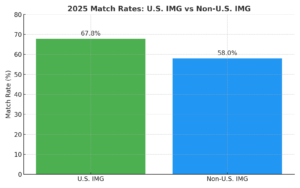
- Non-U.S. IMG match rate: 58.0% (down 0.5%)
- U.S. IMG match rate: 67.8% (up 0.8%)
The data confirms that match outcomes differ significantly for U.S. IMG vs Non-U.S. IMG applicants.
2. U.S. Legal Status: A Hidden Advantage in Program Eligibility
Visa sponsorship is a separate eligibility question. A non-U.S.-citizen IMG with permanent residence generally does not need J-1 or H-1B sponsorship, while another non-U.S.-citizen IMG may require it. Check each program’s accepted work authorization, sponsorship policy and appointment requirements. Citizenship-based aggregate match rates do not isolate the effect of needing a visa; the illustrative 150-versus-50 program counts are not established eligibility estimates.
3. Primary Care is Still the Gateway — But It’s Getting Tougher
- Internal Medicine: 96.8% fill rate
- Family Medicine: 85.0% fill rate (down)
- Pediatrics: 95.3% fill rate (rebounded)
4. IMG-Friendly Specialties in 2025
- Pathology: 27% IMG
- Neurology: 28% IMG
- Psychiatry: Strong uptake
5. Transitional and Preliminary Year Slots: Strategic Entry Points
Over 2,200 Prelim/TY slots were offered — many filled by IMGs using these positions as stepping stones to categorical roles.
6. SOAP is Shrinking — Plan Ahead
Only 2,521 positions were available via SOAP in 2025. That’s down from 2024, despite more total Match positions. It’s not a dependable backup plan.
Top 5 Questions IMGs Are Asking Right Now
- Is it getting harder for Non-U.S. IMGs? The 2025 aggregate rate does not identify visa sponsorship as the cause. Non-U.S.-citizen IMGs include applicants with different work-authorization needs.
- Which specialties are best for IMGs? Internal Medicine, Neurology, Pathology, Pediatrics.
- Does green card or U.S. citizenship help? Work authorization can affect program eligibility. Permanent residents remain non-U.S.-citizen IMGs in NRMP statistics; confirm each program’s policy.
- Are Prelim/TY years worth it? Yes — for gaining U.S. experience and strong LORs.
- Should I count on SOAP? No — it’s shrinking and hyper-competitive.
IMGPrep Match Smarter Not Harder!!
Contact Us
IMGPrep LLC, 4000 Legato Rd. Suite 1100
Fairfax, VA 22033
Fairfax, VA 22033
Fax: +1 (202) 751-2590